
Nestled in the hills of Wayanad, Kerala, this home by Whimpro grows from a family’s memories yet feels like a quiet resort, with minimal lines, warm materials, and modern details framing views and light. Every corner is designed to feel like turning a page in a storybook—soft transitions, curated views, and calm volumes that let the landscape and the people living inside become the main characters
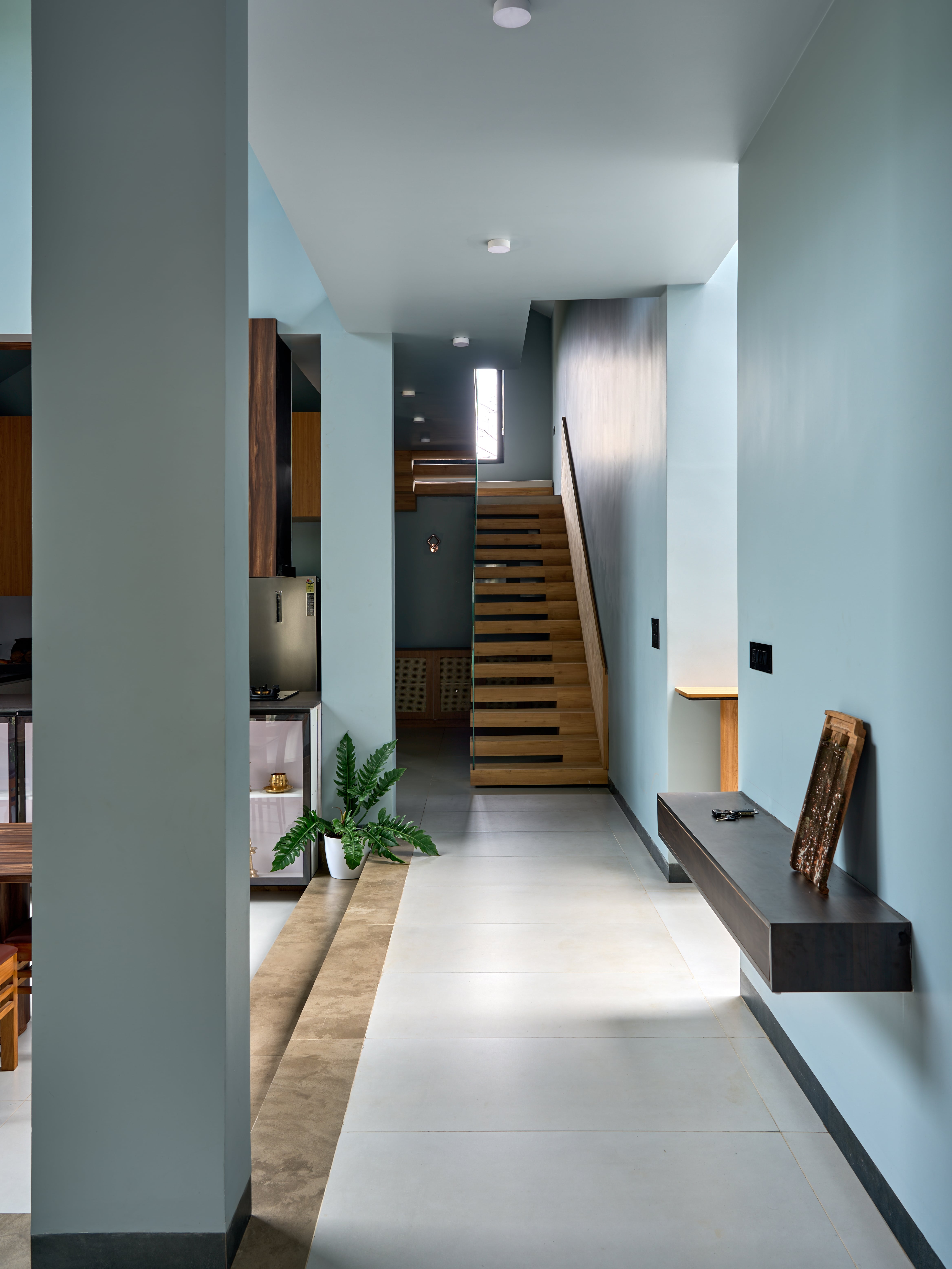
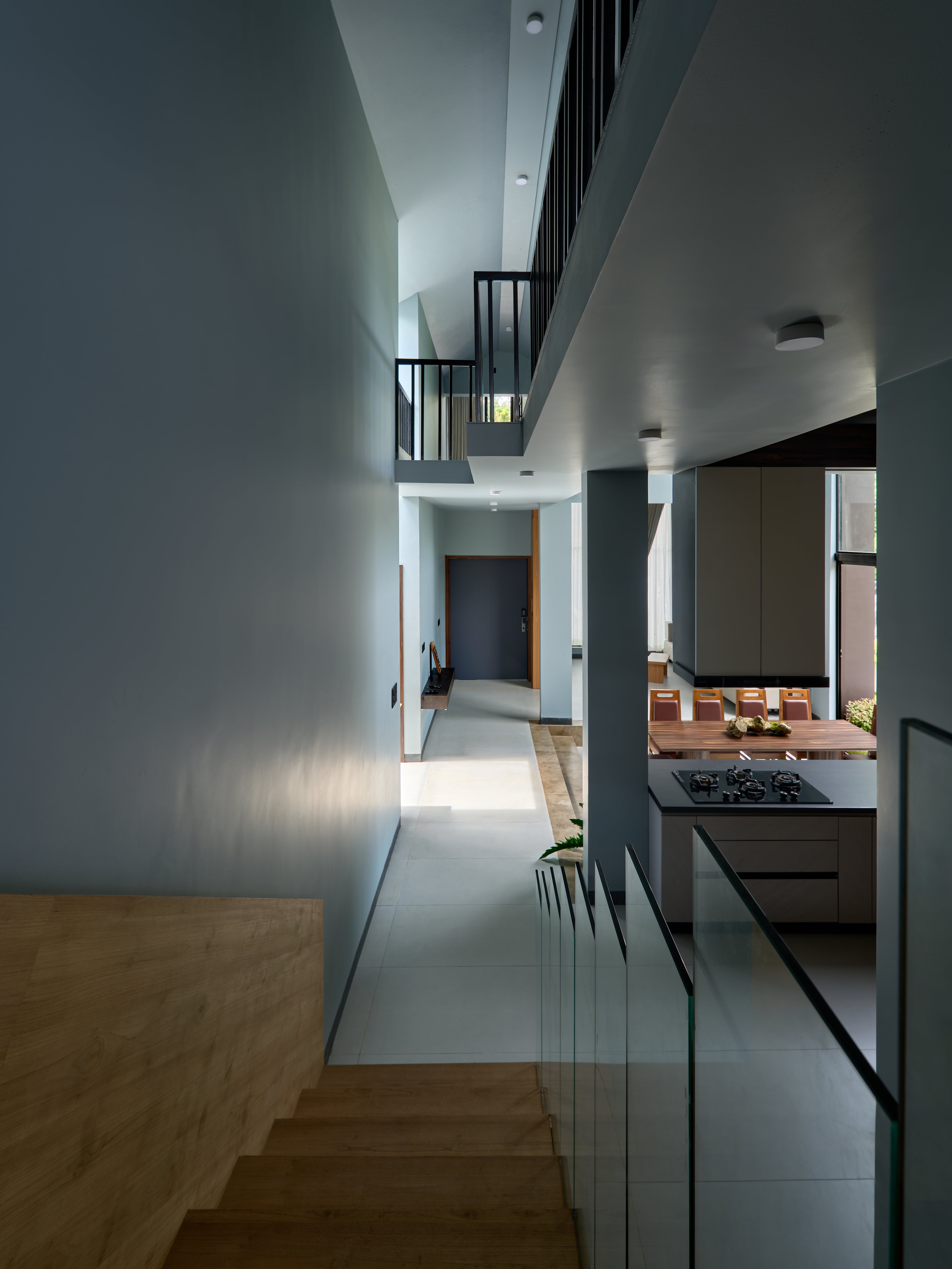
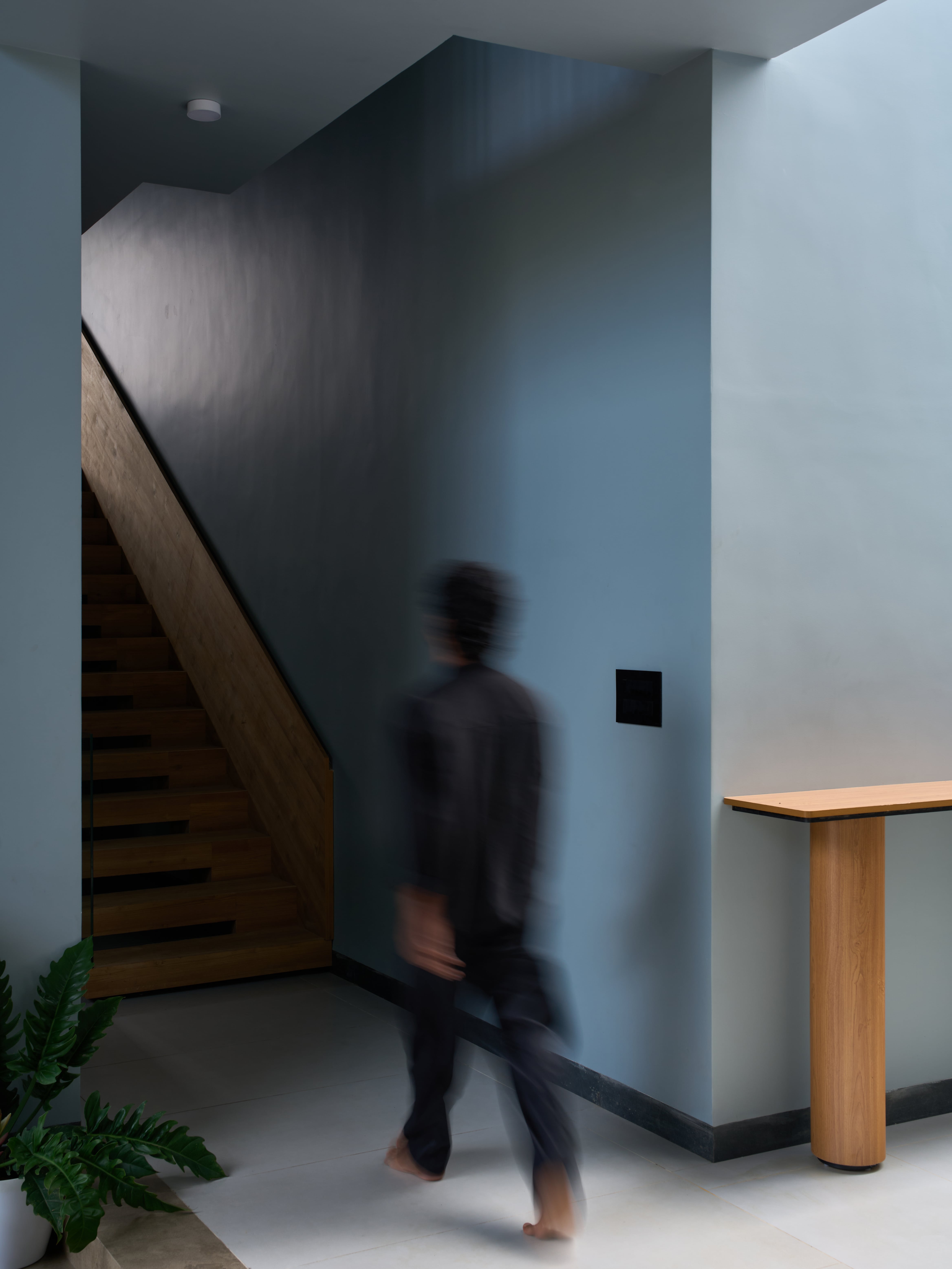
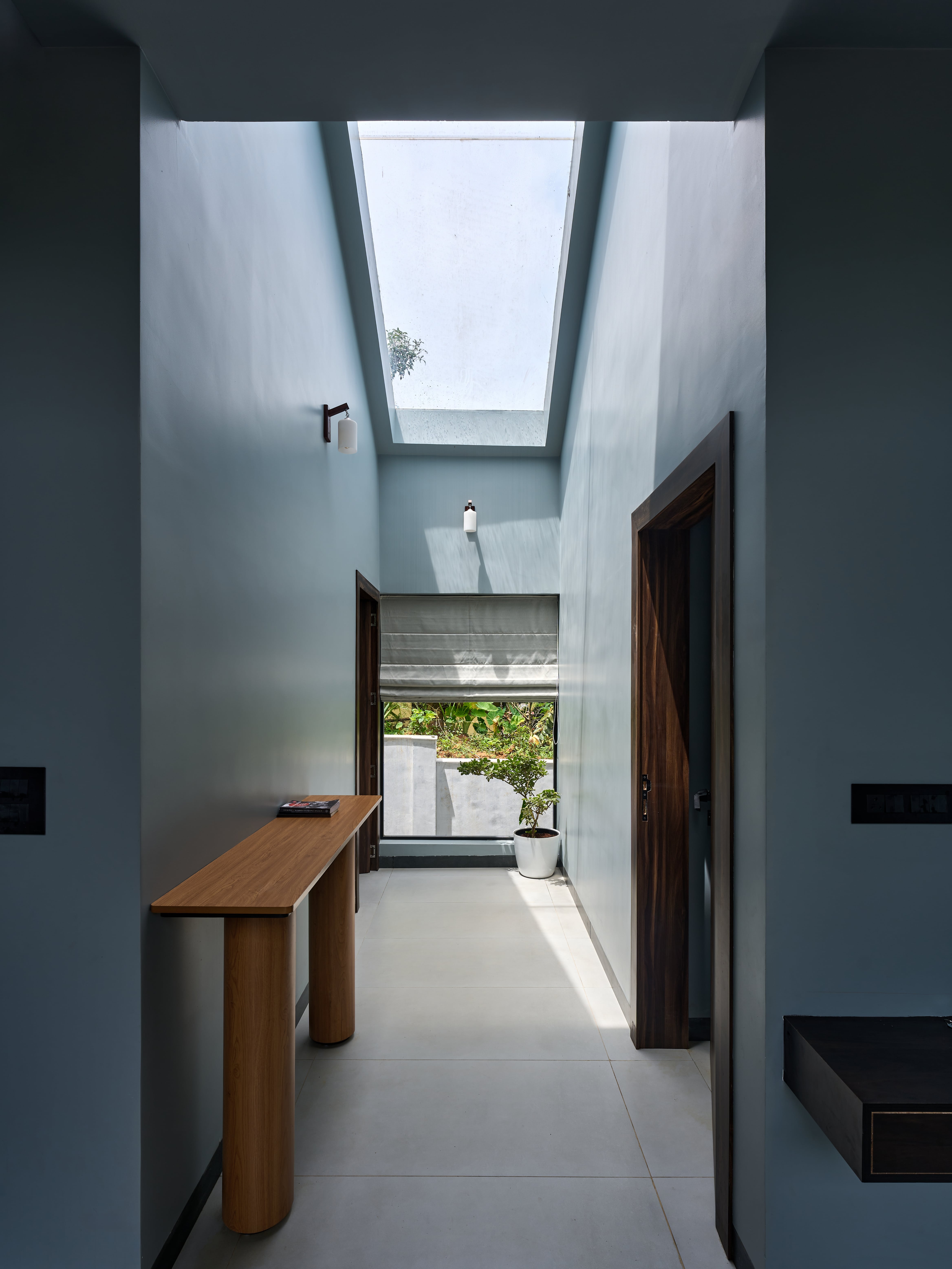
The “slender passage of light and shadow” sets the tone right away. It’s not just a corridor but a transition zone — a quiet introduction that shifts you from the outside world to the private interior realm. The way light falls here creates rhythm and movement, animating the walls and drawing the eye forward. The warm wooden stair at the end becomes a visual anchor, suggesting ascent and continuity — both physical and emotional — inviting the person deeper into the home’s experience.
Soft blue walls against natural timber form a dialogue between cool and warm tones, enhancing a sense of balance and calm. The use of simple planes and minimal detail refrains from distraction, allowing the quality of light and material texture to lead. The single green plant is a subtle punctuation — a reminder of nature’s quiet presence inside, softening the modernity with life. Altogether, these cues turn the house into an everyday retreat, designed not to impress but to soothe.
Placing the dining table directly in line with the entry is a beautiful architectural gesture. It’s an act of openness and hospitality, positioning togetherness at the heart of the home. Before exploring further, you’re greeted by a scene of sharing — food, conversation, warmth. This is spatial storytelling through alignment and perspective, where the home’s values are evident in its layout: connection first, privacy and rest later.
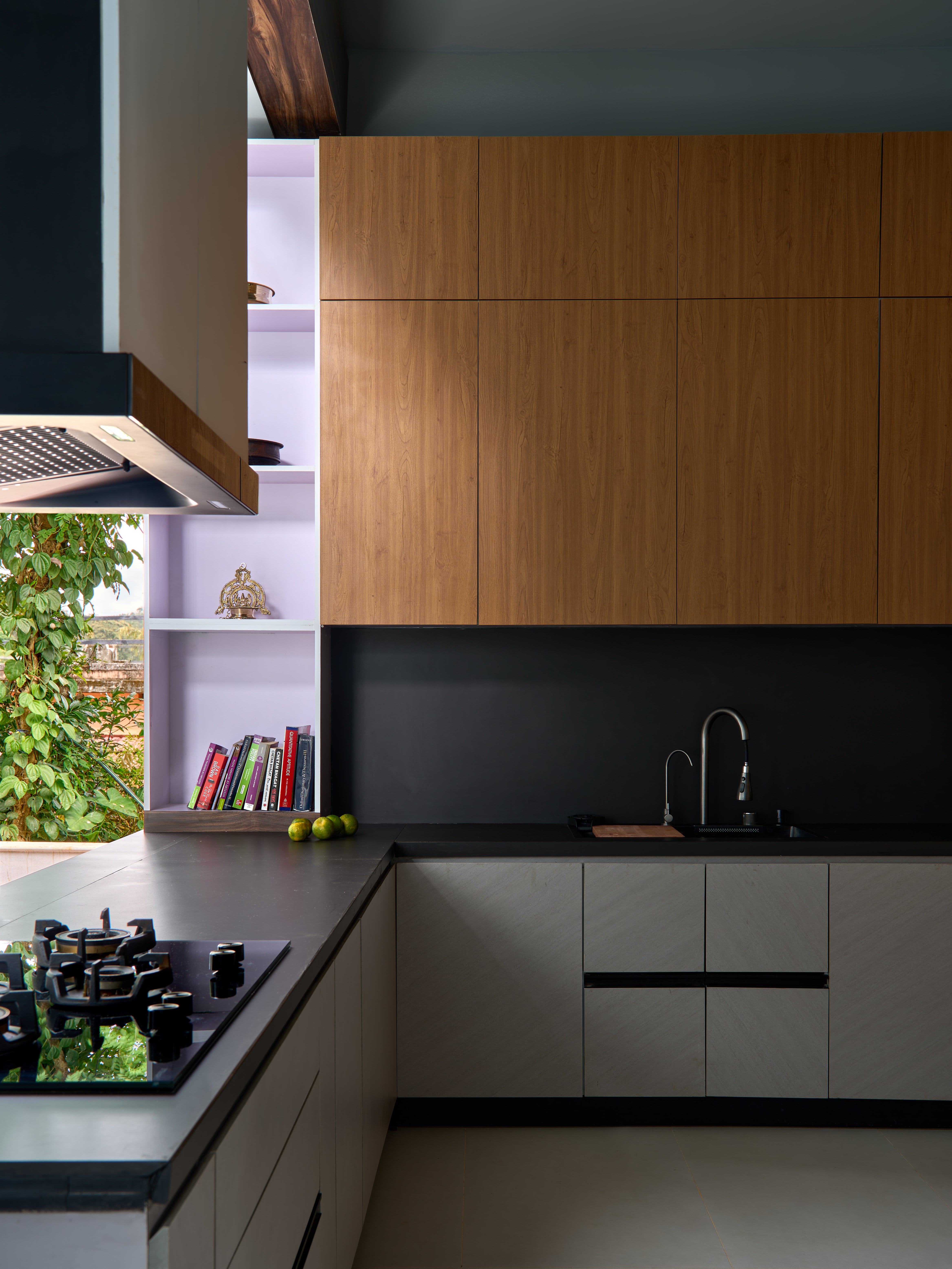
Behind the dining area, the cabinetry merges functionality with personality. Closed timber panels keep the space clean and serene, while lighter open niches offer moments of individuality — displaying books, artefacts, or heirlooms. The contrast between concealed and revealed items mirrors the home’s broader philosophy: comfort through simplicity, and character through subtle detail. These small, curated layers frame daily life like a living gallery, celebrating both order and emotion.
wooden dining table and chairs sit exactly in line with the door, so the house immediately offers a place to gather—this is a home that welcomes you to sit, talk, and share food before anything else. The cabinetry behind, with its mix of closed timber and lighter display niches, layers depth into the view; for a home lover, this reads as both practical storage and a styled backdrop where books, artefacts, and small brass pieces can quietly tell the family’s story
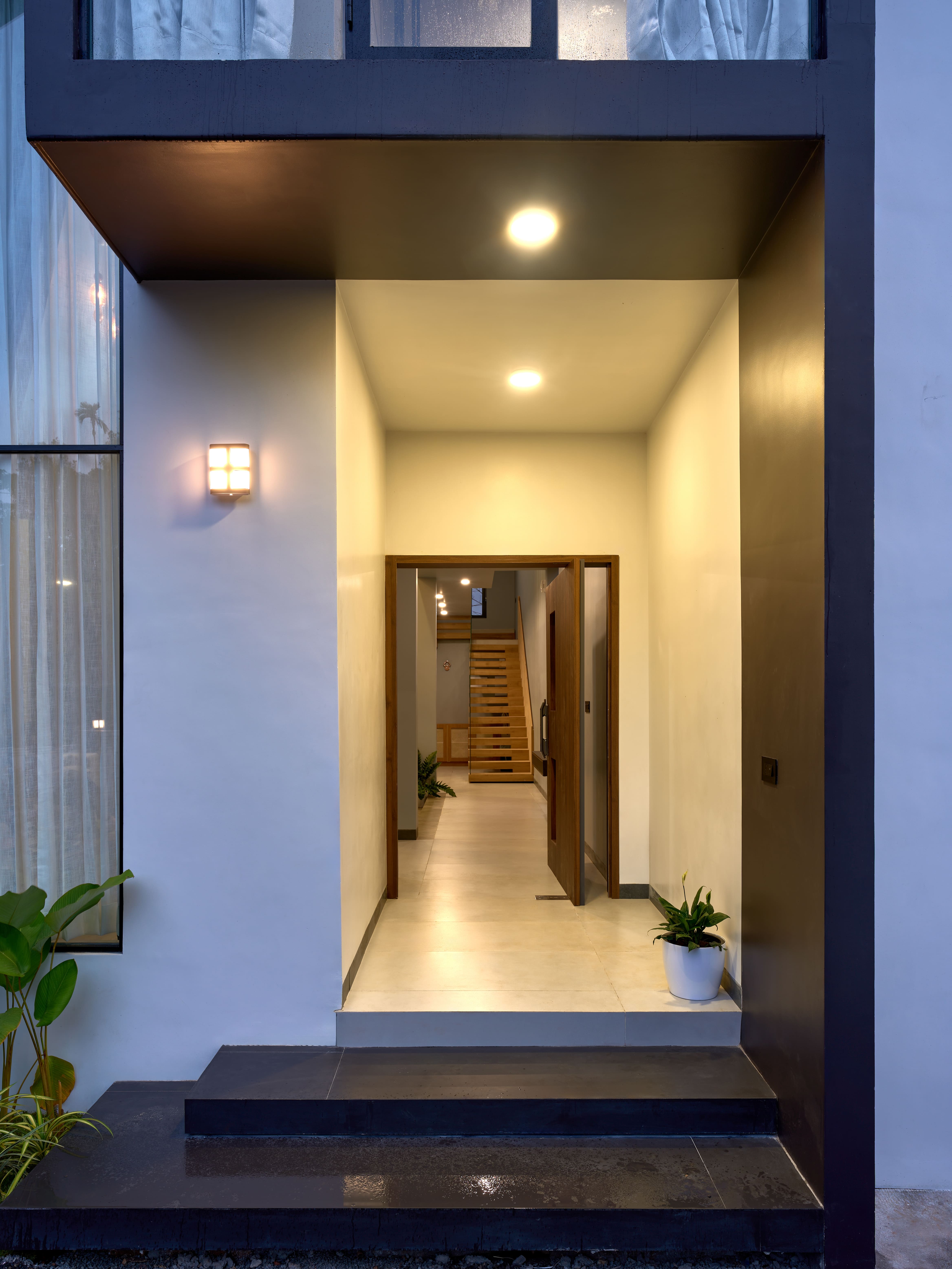
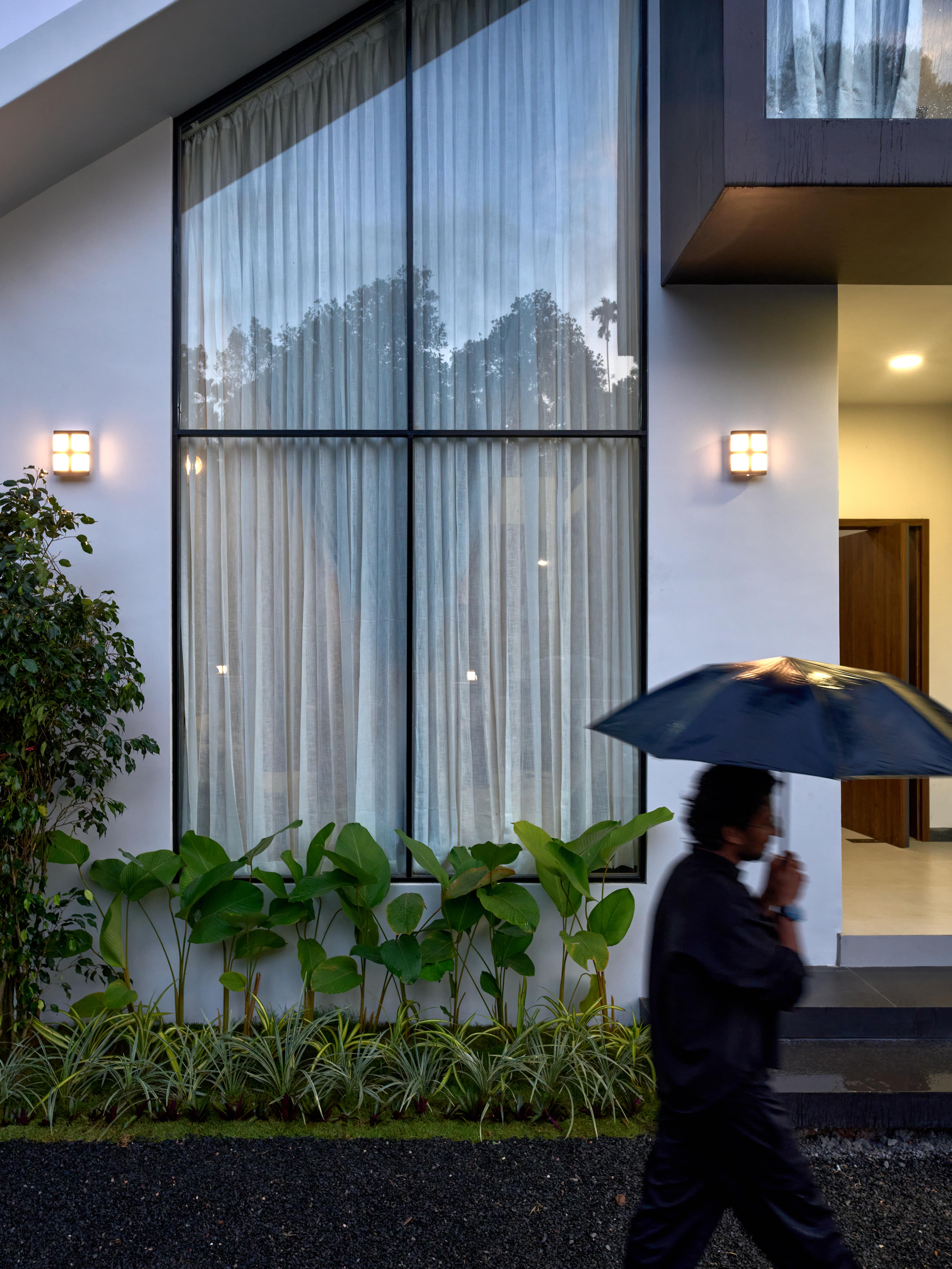
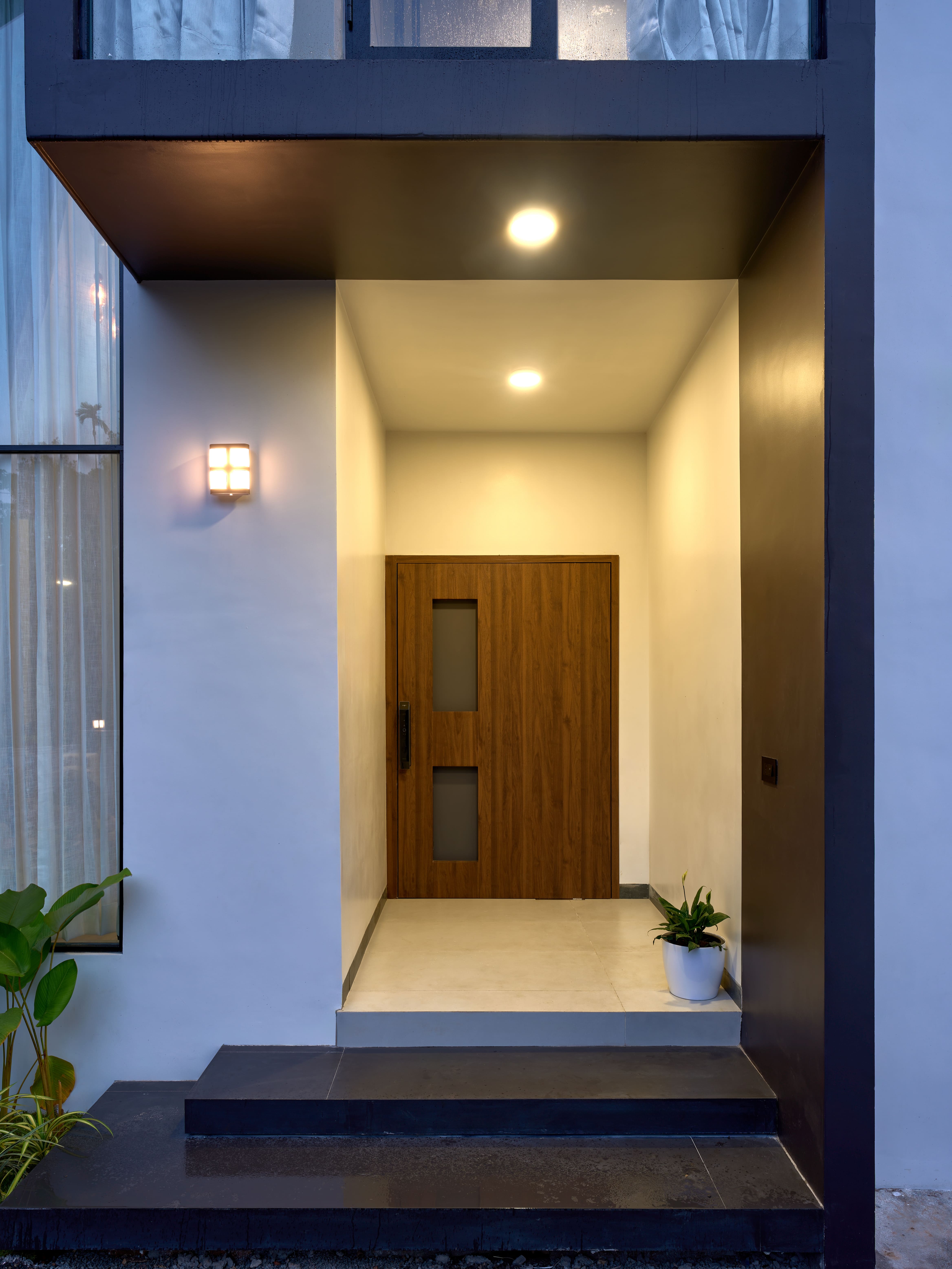
The custom Pivora pivot door is the opening sentence of the house, setting the tone long before a single word is spoken inside. Its flush timber surface reads as one calm plane from the street, framed by a deep portal that heightens the sense of arrival and shelters you from rain, glare, and noise outside. The solid door leaf, aligned with the clean white corridor walls, gives an immediate impression of safety and quiet, while the dark surround and soft ceiling lights stage it almost like an artwork at the end of a gallery.
Look closer and the proportioned vertical cut-outs begin to shift that first impression from heavy to inviting. These slender slots act like controlled glimpses into the life beyond—hinting at depth, light, and movement without ever feeling exposed. During the day, they read as fine lines of brightness that animate the timber; at night, they reverse, allowing a warm inner glow to filter out into the entry recess, so the facade feels lived-in rather than stark. This balance between solid and slit, opaque and luminous, quietly announces that the interior will be contemporary, but in a human, tactile way—more retreat than showpiece.
As the door pivots, the experience becomes almost cinematic. Unlike a conventional hinged shutter that simply swings aside, this leaf arcs slowly on its vertical axis, widening the threshold in one smooth, generous gesture. The floor and ceiling planes stay uninterrupted, so you feel the entire wall opening rather than just a panel moving, which makes every entry—whether returning from work or welcoming friends—feel like a small ceremony. There is a pause as the door turns, like the deliberate act of opening a heavy, linen-bound book; the first step inside becomes the first line of a story you are about to inhabit. That sense of ritual extends into how the pivot door frames the long corridor and stair beyond. The moment it clears, your eye is drawn straight through the quiet passage to the warm timber staircase at the far end, a composition of light, shadow, and material that is carefully choreographed from the outside. The dark stone plinth, pale floor, and small potted plants reinforce this axis, guiding you gently inward and upward. In this way, the Pivora pivot door is not only an object of joinery but the key narrative device of Fench House—announcing its values of calm, craft, and generosity before a single internal space is seen.
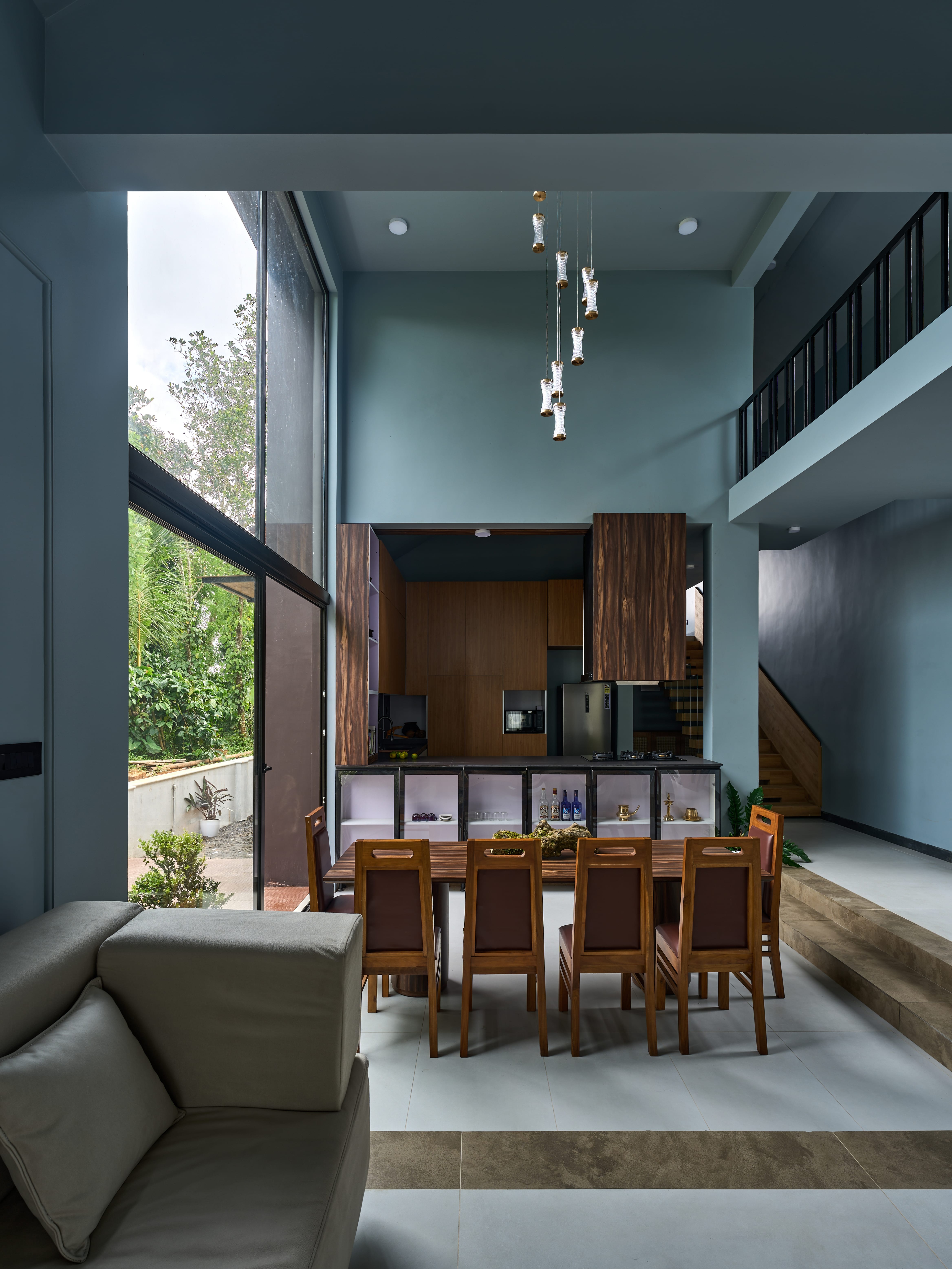
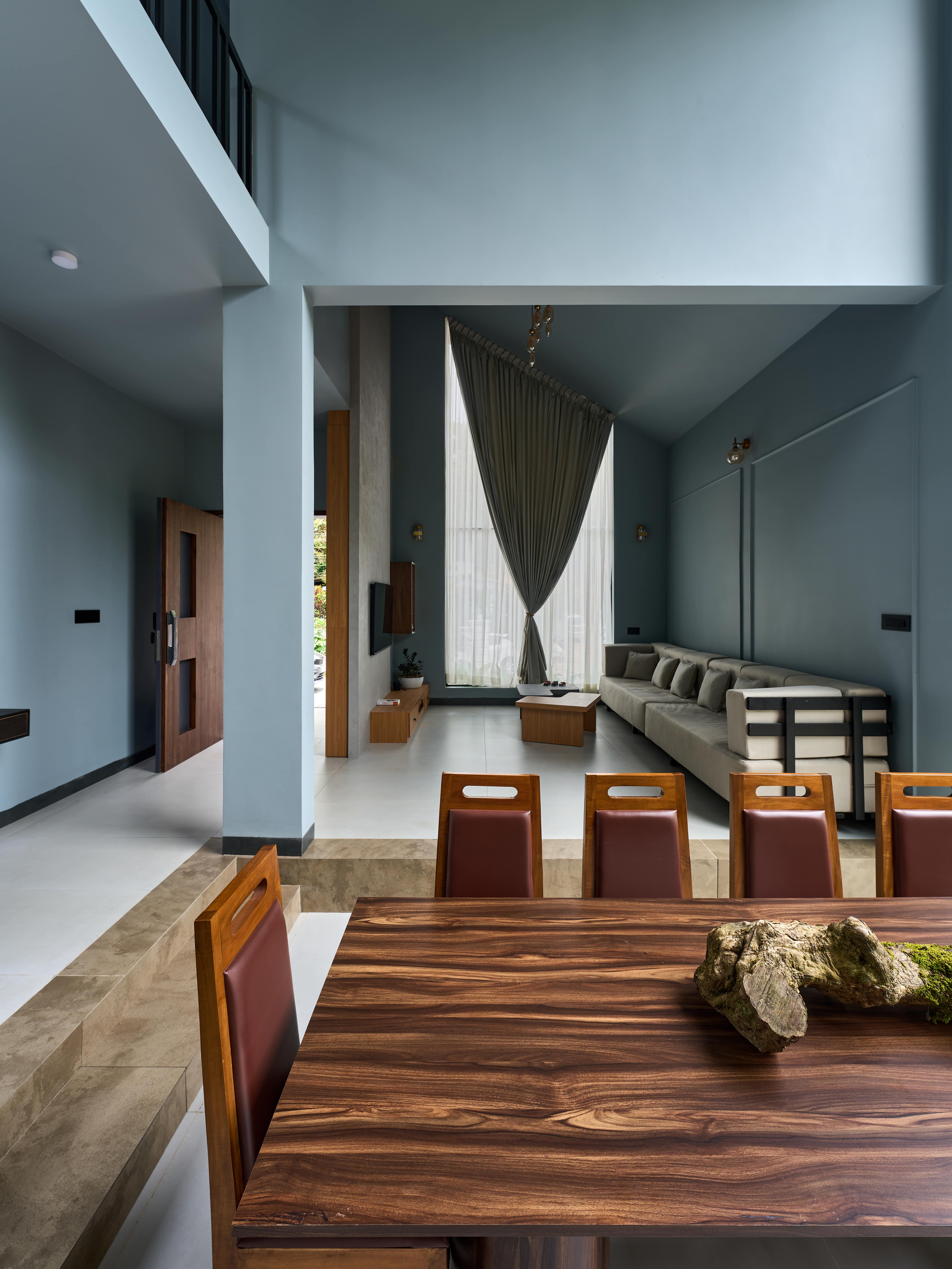
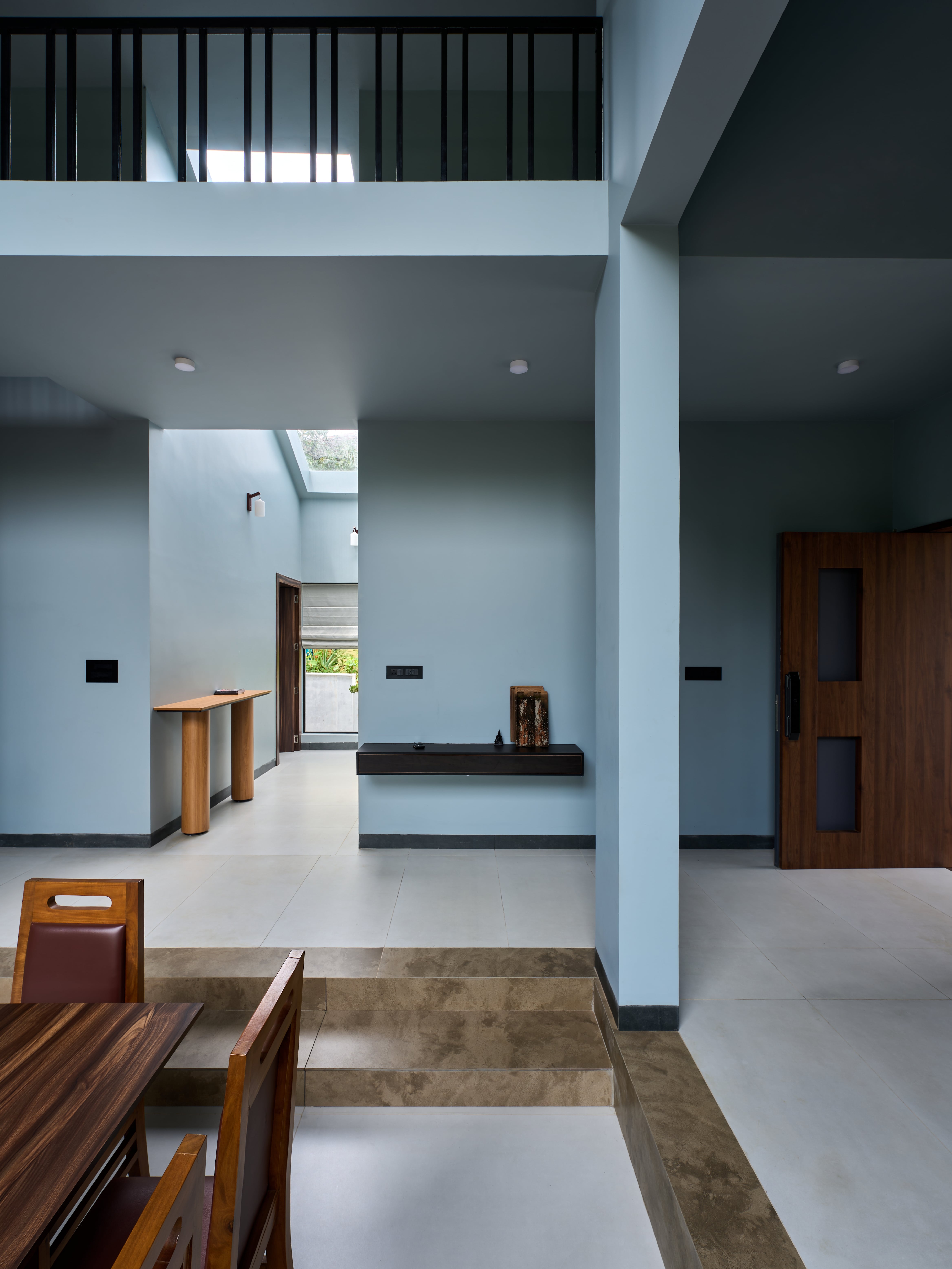
The heart of Fench House reveals itself the moment the corridor releases you into the soaring volume of the living–dining space. Here, the house opens up in one deliberate breath: a tall soft-blue shell, a continuous floor plane, and a single timber dining table placed exactly on axis with the entry, as if the entire home has been composed around the idea of gathering. The transition from the compressed passage to this double-height room feels like stepping into a quiet courtyard of light, where walls recede, ceiling lines lift, and the architecture gently shifts from protection to openness.
In this central room, colour and proportion do most of the work. The enveloping blue-grey tone wraps walls and ceiling alike, dissolving edges and allowing the eye to travel uninterrupted from the low, intimate sofa corner to the lofty void over the dining table. Natural light pours in from the full-height glazing, catching the grain of the timber furniture and the matte finish of the floor, creating a steady, calm brightness rather than dramatic contrast. The result is a space that feels simultaneously tall and grounded—its vertical generosity balanced by the warmth of wood and the restraint of a minimal palette.
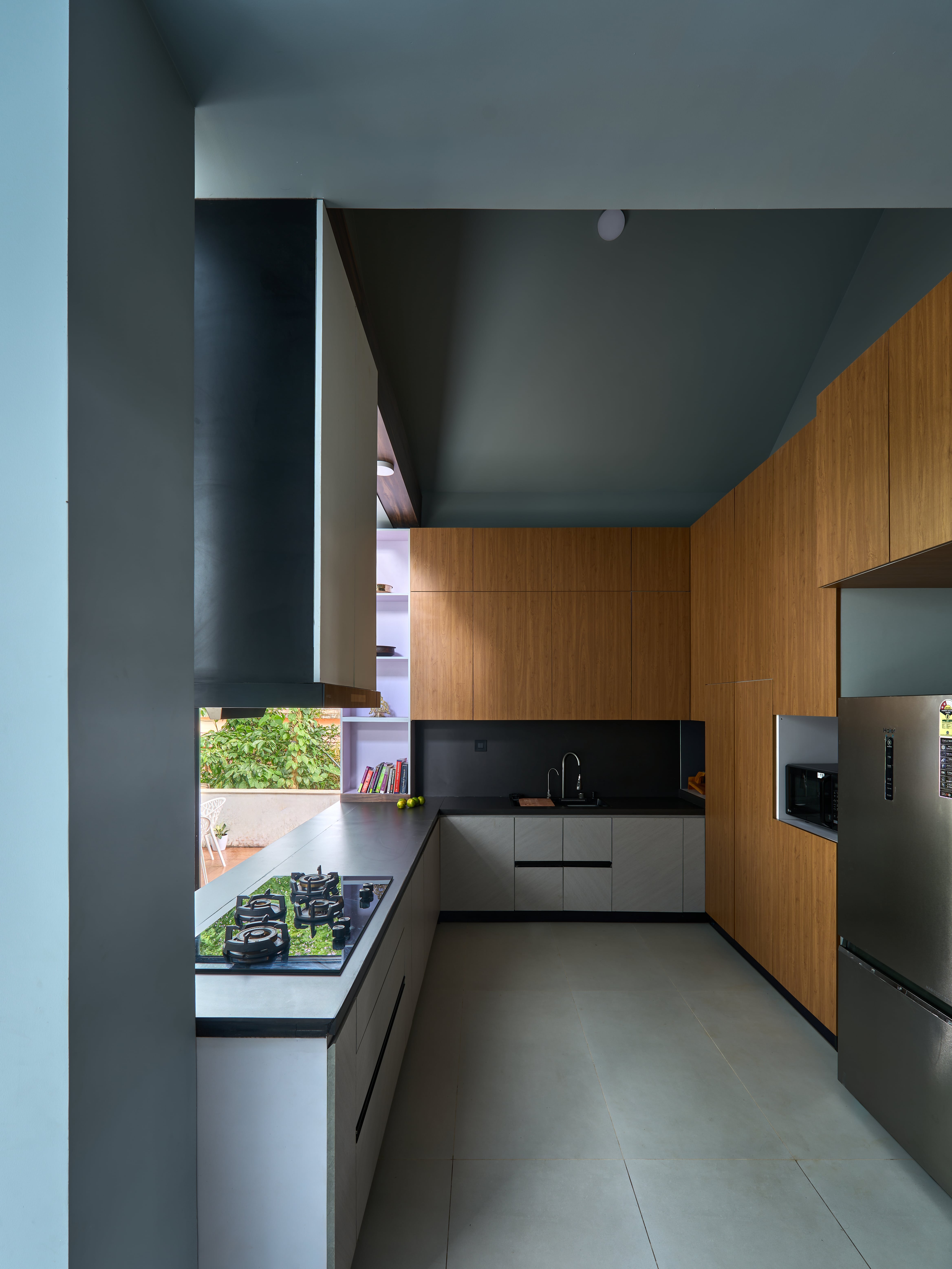
The dining table stands as the social anchor of the home. Its length and placement make an unmistakable statement: this is a house that asks you to sit, talk, and share food before you disperse into private rooms. Behind it, the cabinetry composition reads almost like a stage set—solid timber blocks, recesses for appliances, and lighter display niches that can hold bottles, glassware, and small artefacts. When viewed from the living area or from the stair, these cabinets form a thickened backdrop, giving depth to the volume and visually tying the kitchen to the dining without clutter. The bar-like counter with backlit storage adds a subtle hospitality note, turning everyday meals into occasions.
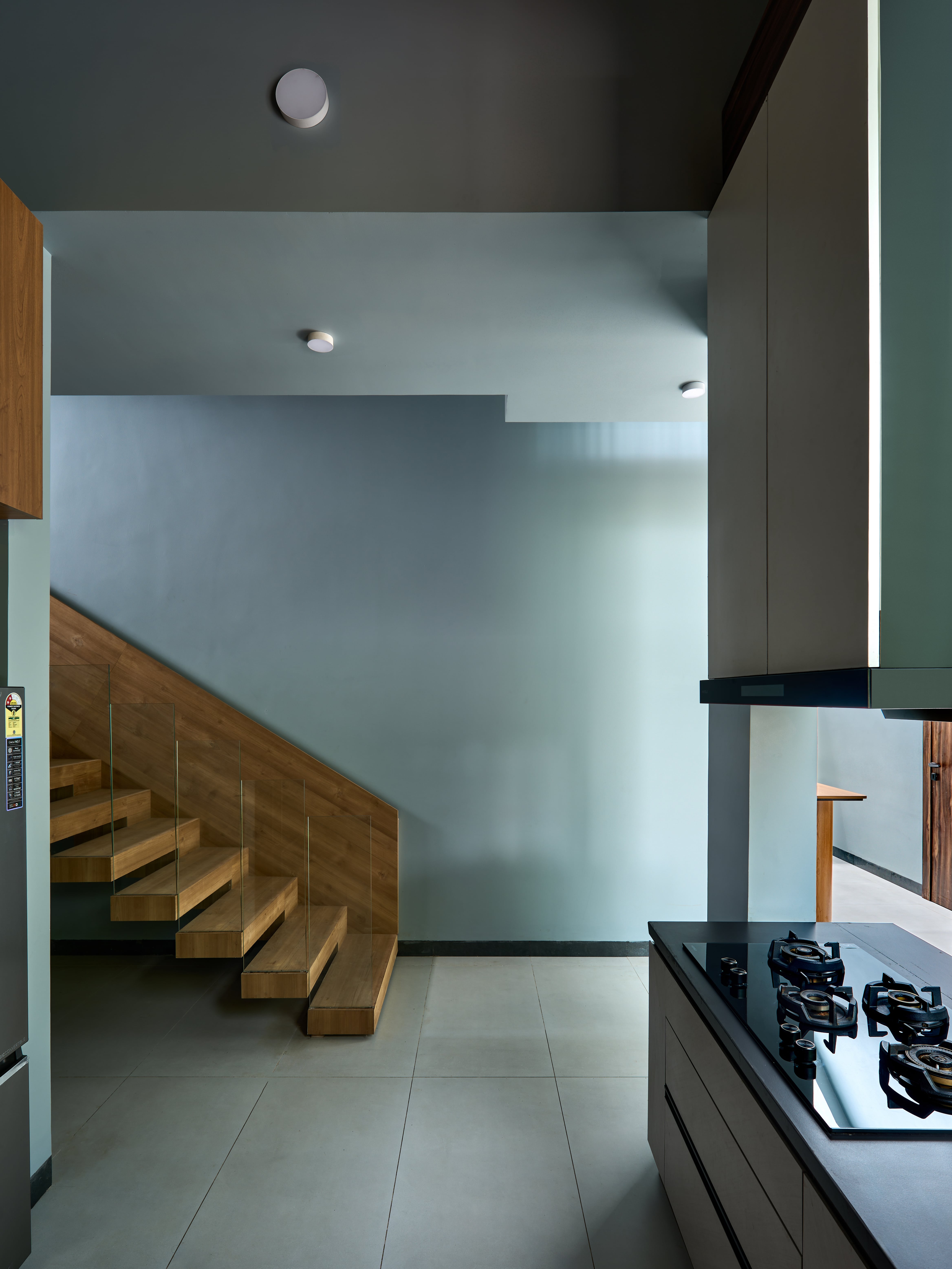
Around this central table, the other elements are carefully lowered in tone so that the space never feels busy. The linear sofa along the wall is deliberately quiet—soft cushions, clean lines, and a neutral fabric that seems to merge with the painted wall, allowing people rather than furniture to become the focus. Low timber coffee tables echo the dining surface, their rounded corners and modest height reinforcing a relaxed living posture. Even the staircase, with its simple timber treads and black handrail, participates in this language of understated geometry, rising as a clear line that connects the social ground level to the more private upper floor without demanding attention.
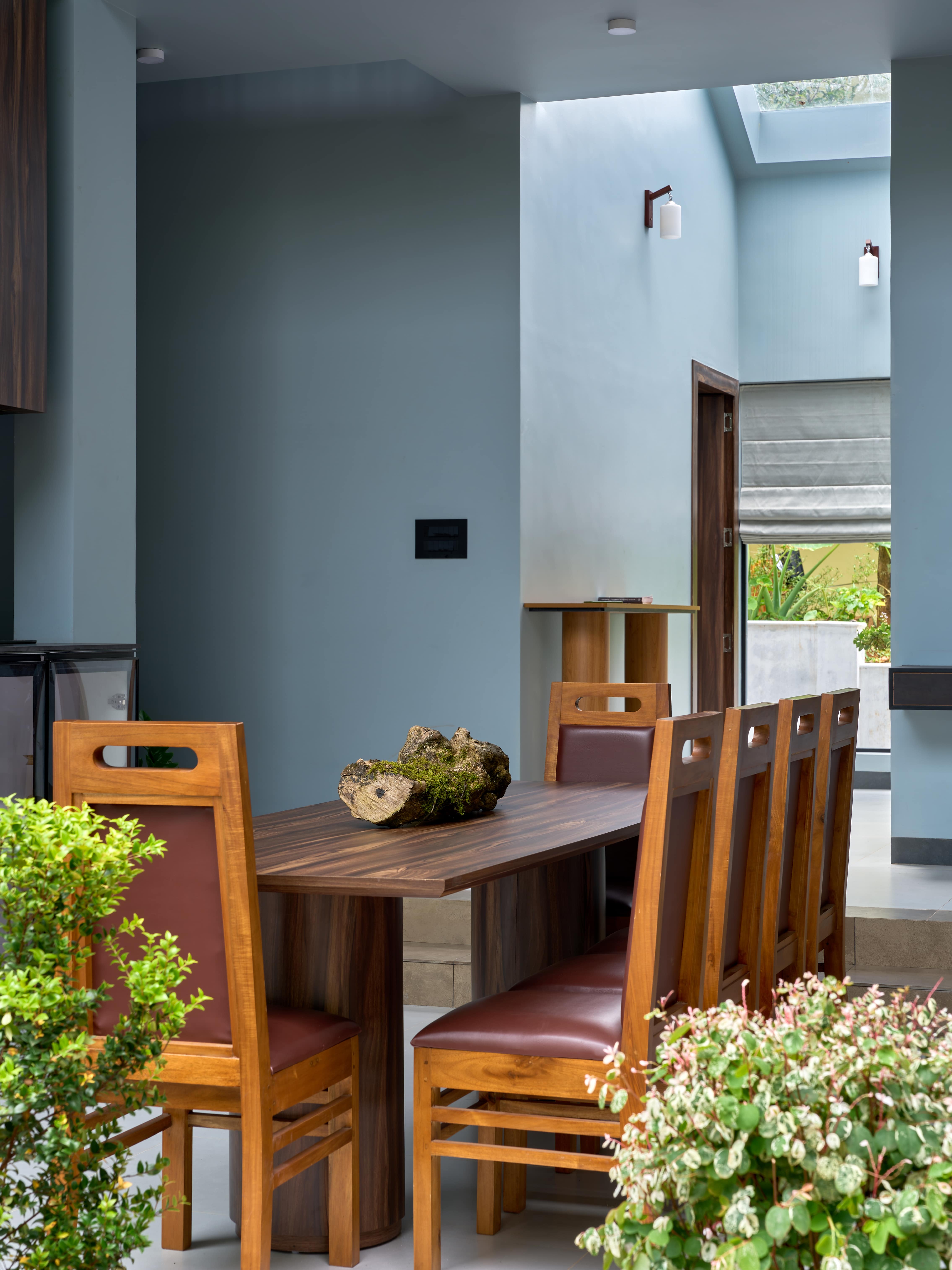
From the garden edge, the character of Fench House comes into focus as a finely balanced dialogue between inside and outside. The dining table sits just a step away from the lawn, close enough that the greenery reads as part of the room’s composition, softening the strong geometry of the blue envelope and the crisp black frame of the façade opening. When the large sliders are open, the timber chairs, plants, and pendant lights align in a single visual axis, so that an everyday meal can effortlessly expand into an informal outdoor gathering.
Within this frame, the architecture quietly layers depth. The first plane is the lush foreground of shrubs and grass, followed by the warm band of timber furniture and the cool expanse of the floor; beyond that, the eye is drawn to the luminous skylit corridor that cuts through the house, ending in a glimpse of yet more planting outside. This sequence makes the dining area feel like the pivot point of the home’s landscape, mediating between the openness of the garden and the quieter, more private rooms, while the soft blue shell and black railings hold everything together as one calm, cohesive volume.

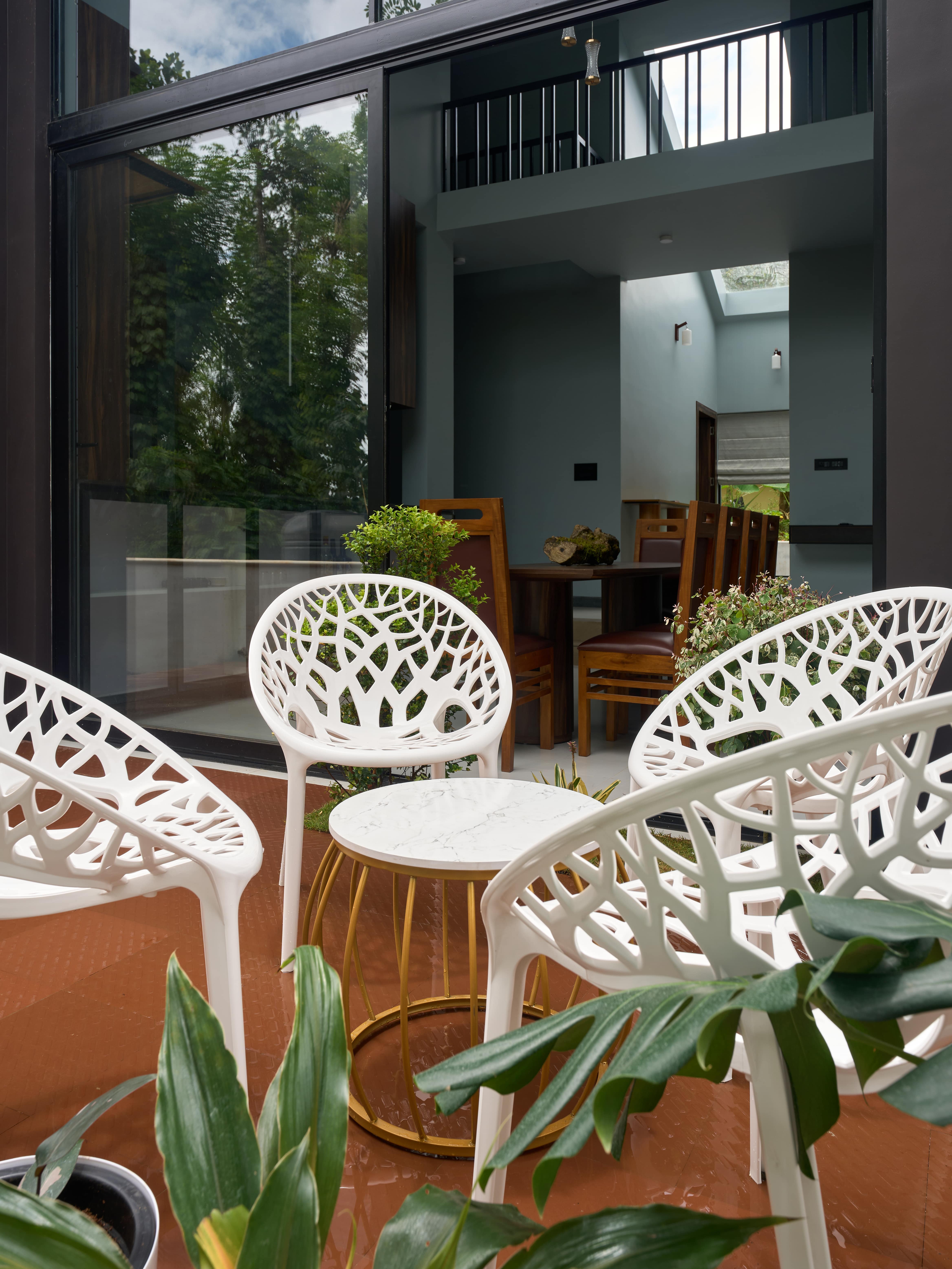
Just outside the tall glass of the dining room, Fench House unfolds a small but decisive outdoor living room—a threshold space where the architecture relaxes into the landscape. A thin metal frame and large sliding panels create an almost invisible boundary, so the terrace feels less like an extension and more like the first room of the garden. The red oxide floor underfoot brings a grounded, earthy warmth, contrasting with the cool blue interior and visually rooting the white chairs and green foliage in a distinctly tropical palette.
The furniture here is deliberately light and sculptural. Leaf-patterned white chairs echo the silhouettes of the surrounding plants, allowing backs and shadows to cast delicate, organic patterns across the terracotta surface. A compact table with a marble top and slender brass base anchors the group without blocking views back into the house, so the eye can travel freely from outdoor seating to dining table and all the way to the skylit corridor beyond. This visual continuity makes the terrace feel like an informal lounge attached to the main social spine of the home, ideal for a morning coffee before stepping inside or an evening drink that spills naturally out from dinner.
As an architectural device, this outdoor living pocket extends the idea of “everyday retreat” that runs through Fench House. It offers a second, looser way of inhabiting the same axis as the dining and kitchen—one that is barefoot, open to breeze and birdsong, and partially screened by potted greens rather than walls. When the glass is open, sound and air move freely between the two settings; conversations can stretch from the timber dining chairs to the patio seats without raising voices, and children can drift between inside and out under a single, continuous volume. In this way, the terrace is not a leftover platform but a carefully tuned living room without a roof, completing the home’s sequence from protected interiors to the softness of the garden.
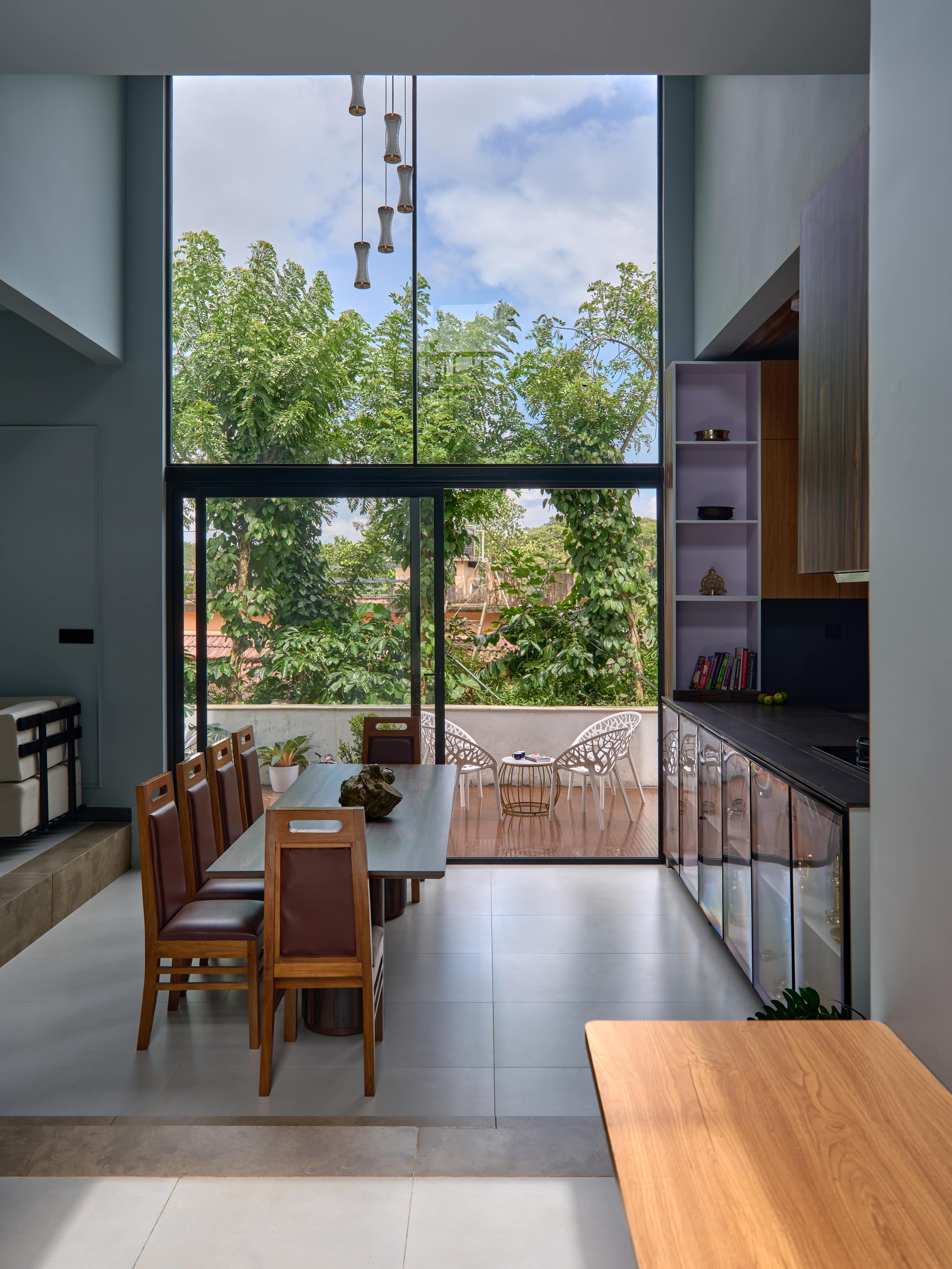
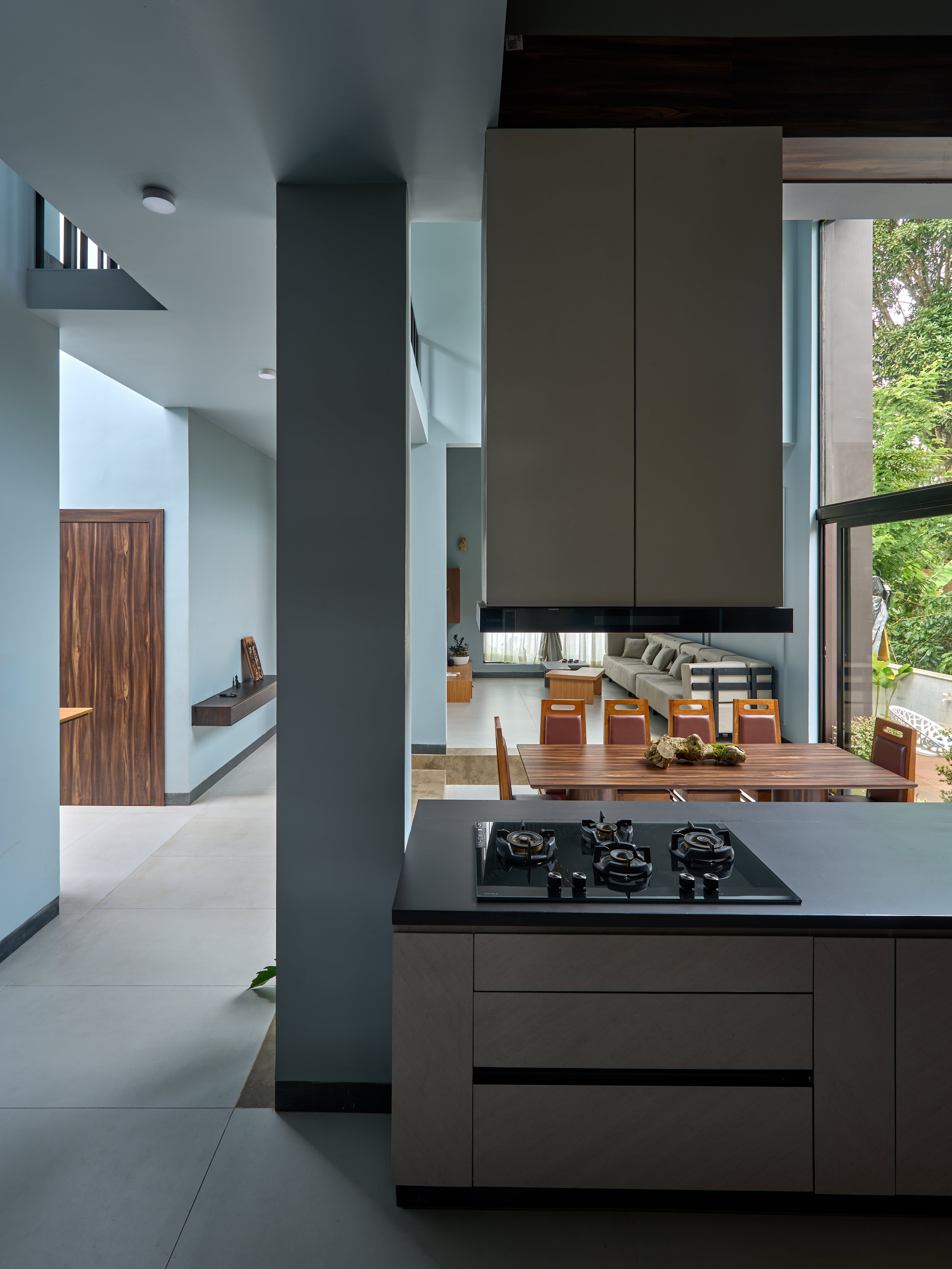
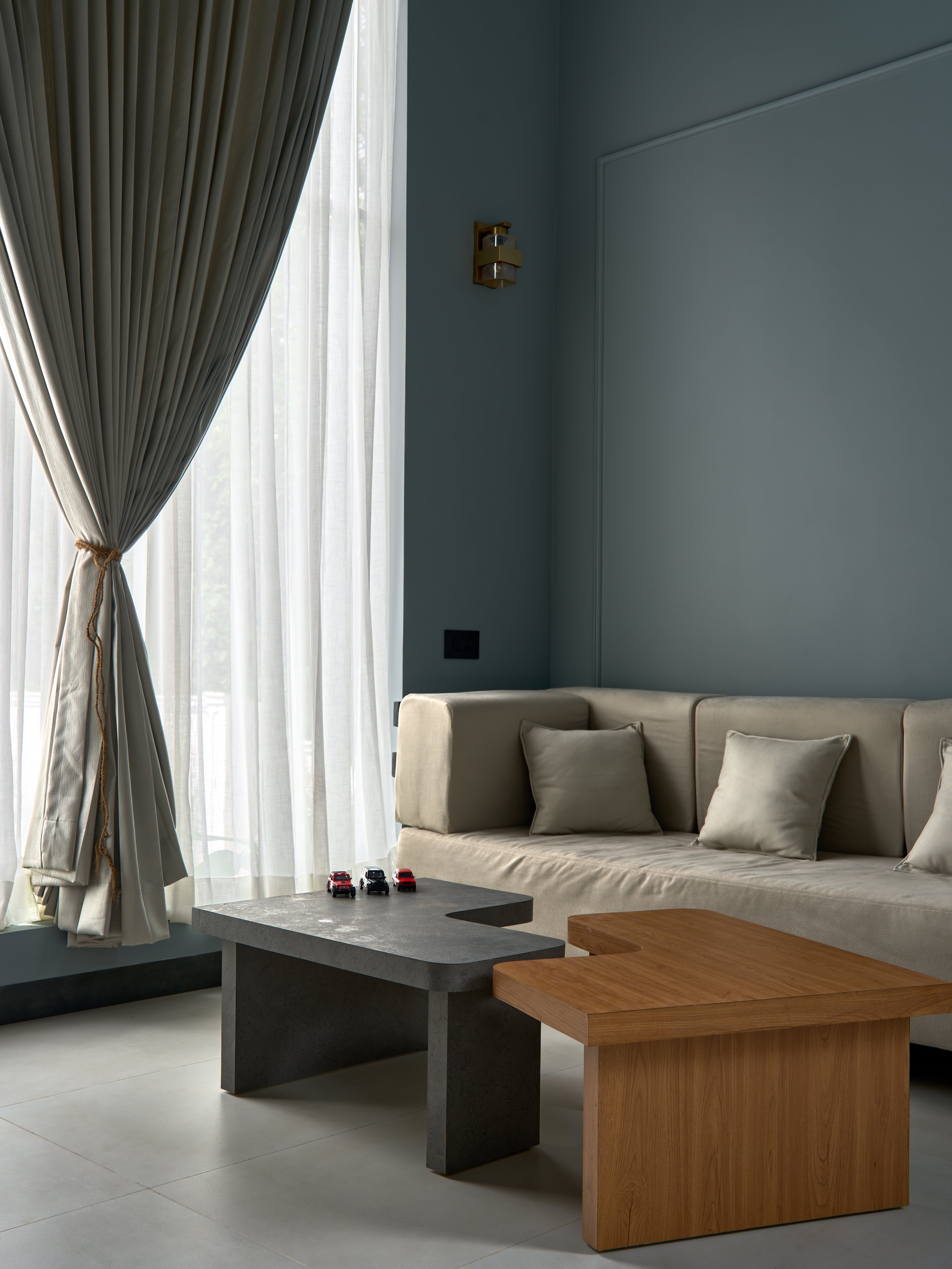
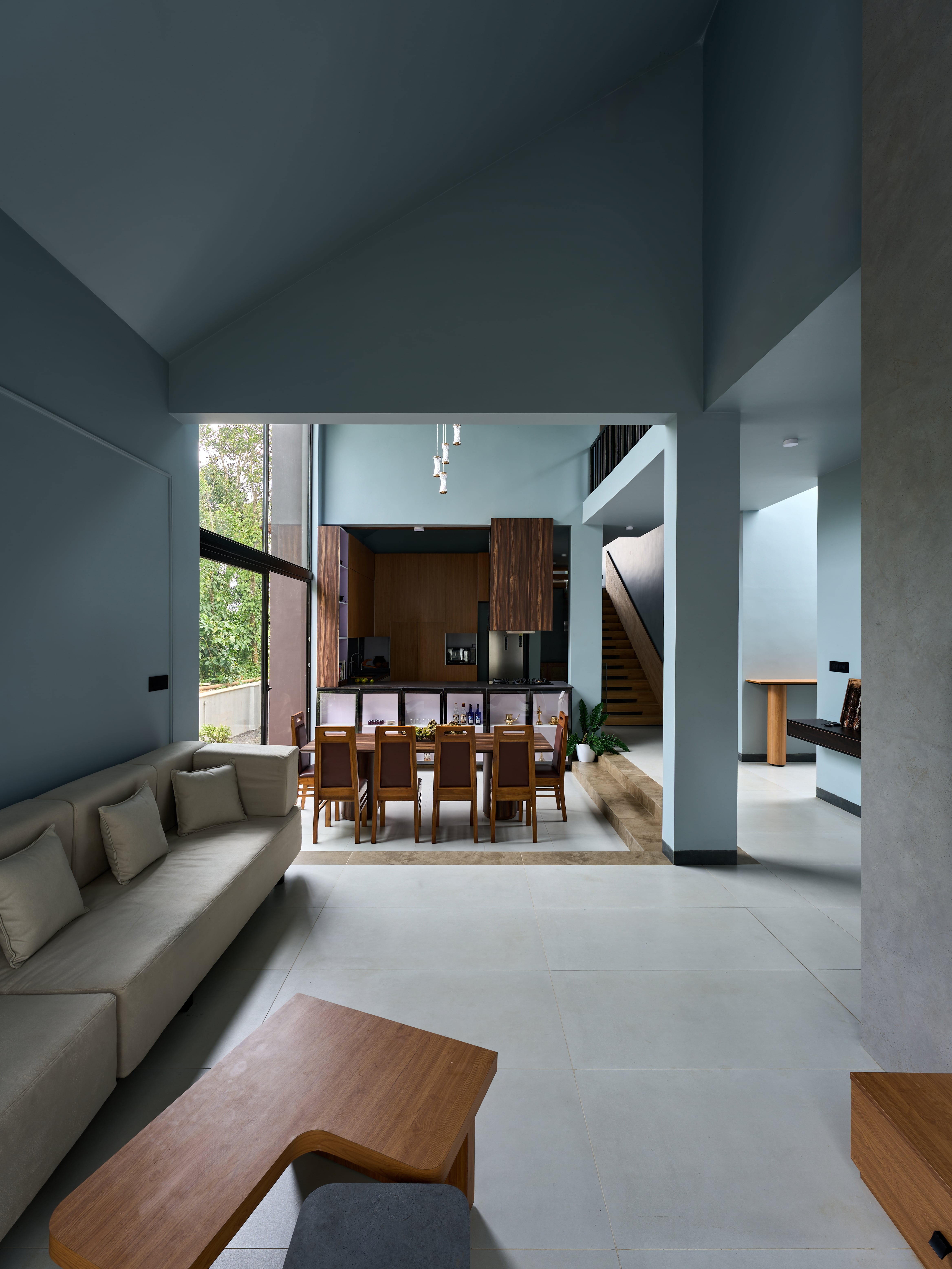
Levels are used as gentle thresholds rather than hard separations. A single step down into the living zone, a slight rise towards the kitchen, and the balcony edge above all help to define distinct pockets of use while preserving the overall continuity of the space. These subtle shifts in floor height and railing lines make the interior feel like a small landscape—plateaus for dining and lounging, a ledge for the bar, a path that continues up the stair. From certain angles, the dining table becomes a kind of fulcrum, visually linking the outdoor green, the living area, and the kitchen core in one wide sweep.
Light, both natural and artificial, choreographs the mood across the day. The tall glass panels pull in views of trees and sky, so that the blue interior sometimes seems to dissolve into the green outside. By evening, the suspended pendant cluster above the dining table creates a vertical moment in the centre of the room, drawing the eye upward and re-emphasising the height of the space while keeping the table itself warmly lit. Smaller wall lights and ceiling spots are positioned to graze surfaces rather than flood them, keeping shadows soft and the atmosphere intimate.
Taken together, these decisions make Fench House feel less like a series of rooms and more like one continuous, habitable volume organised around everyday rituals. The soft colour shell calms, the timber elements add tactility and memory, and the alignment of furniture with architectural axes ensures that every view—whether from the sofa, the stair, or the entry—tells the same story of measured openness. For a home lover, this is not just a photogenic interior; it is an everyday escape where proportion, light, and material quietly conspire to make gathering, resting, and living feel effortlessly natural.
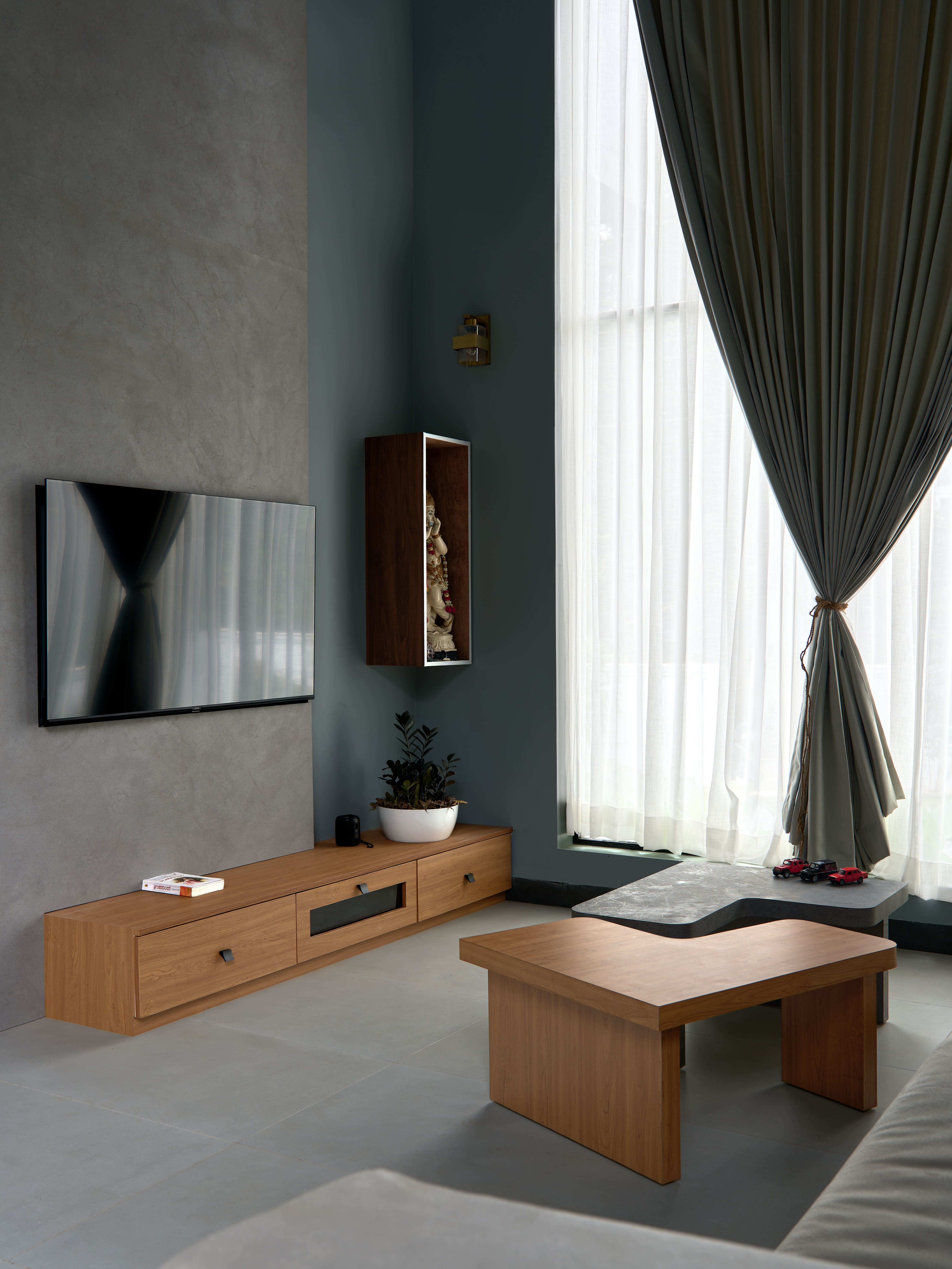
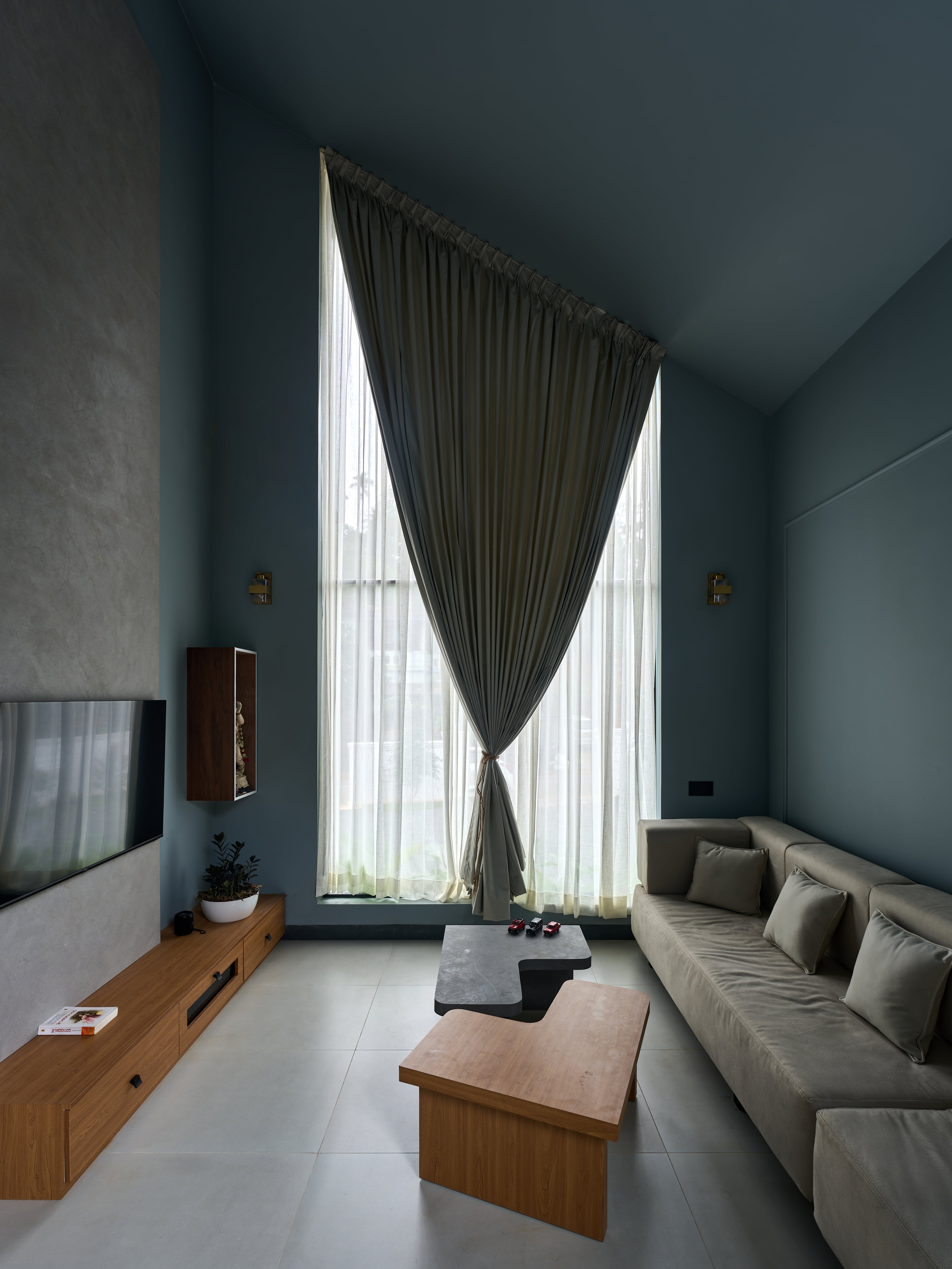
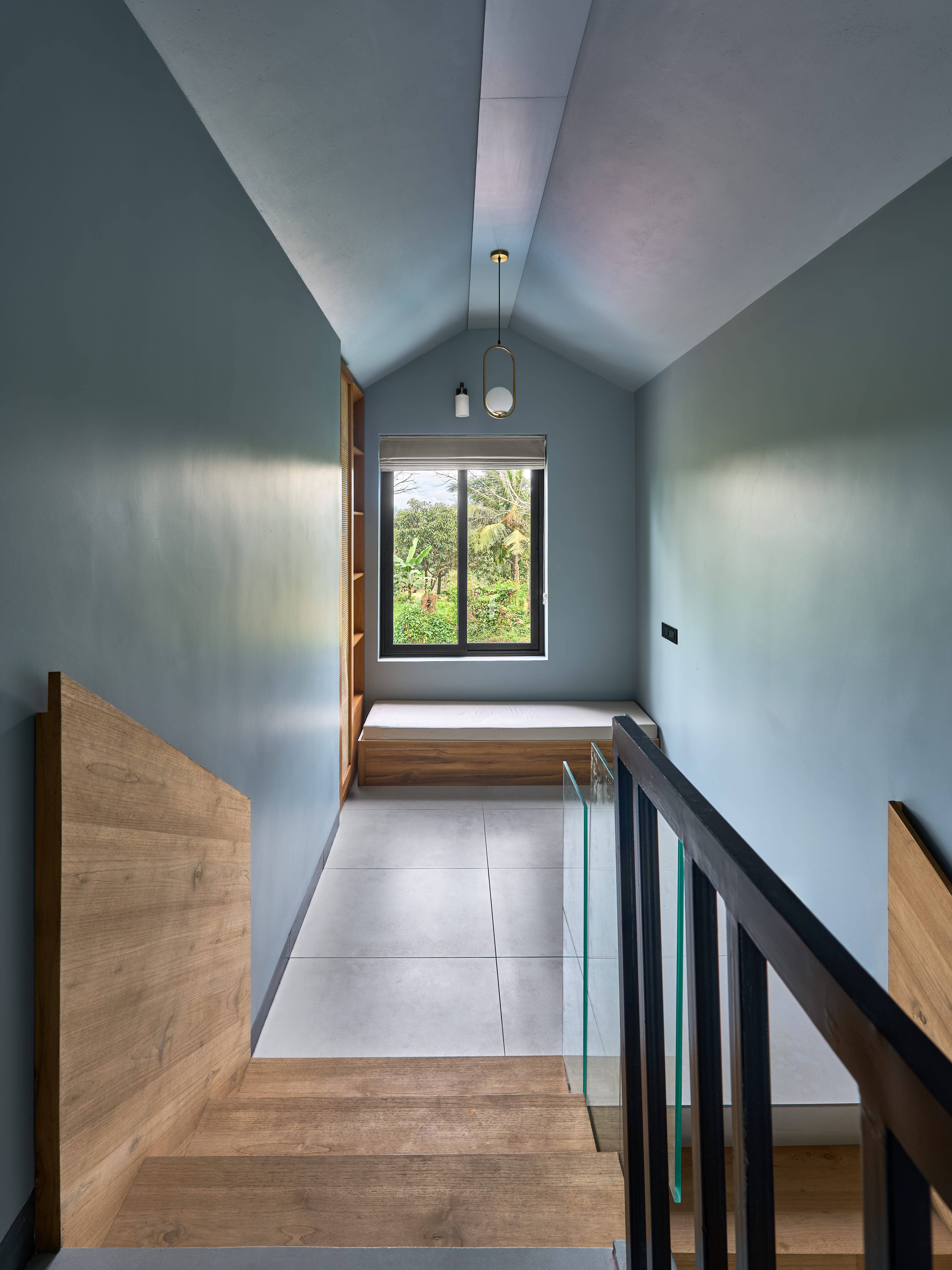
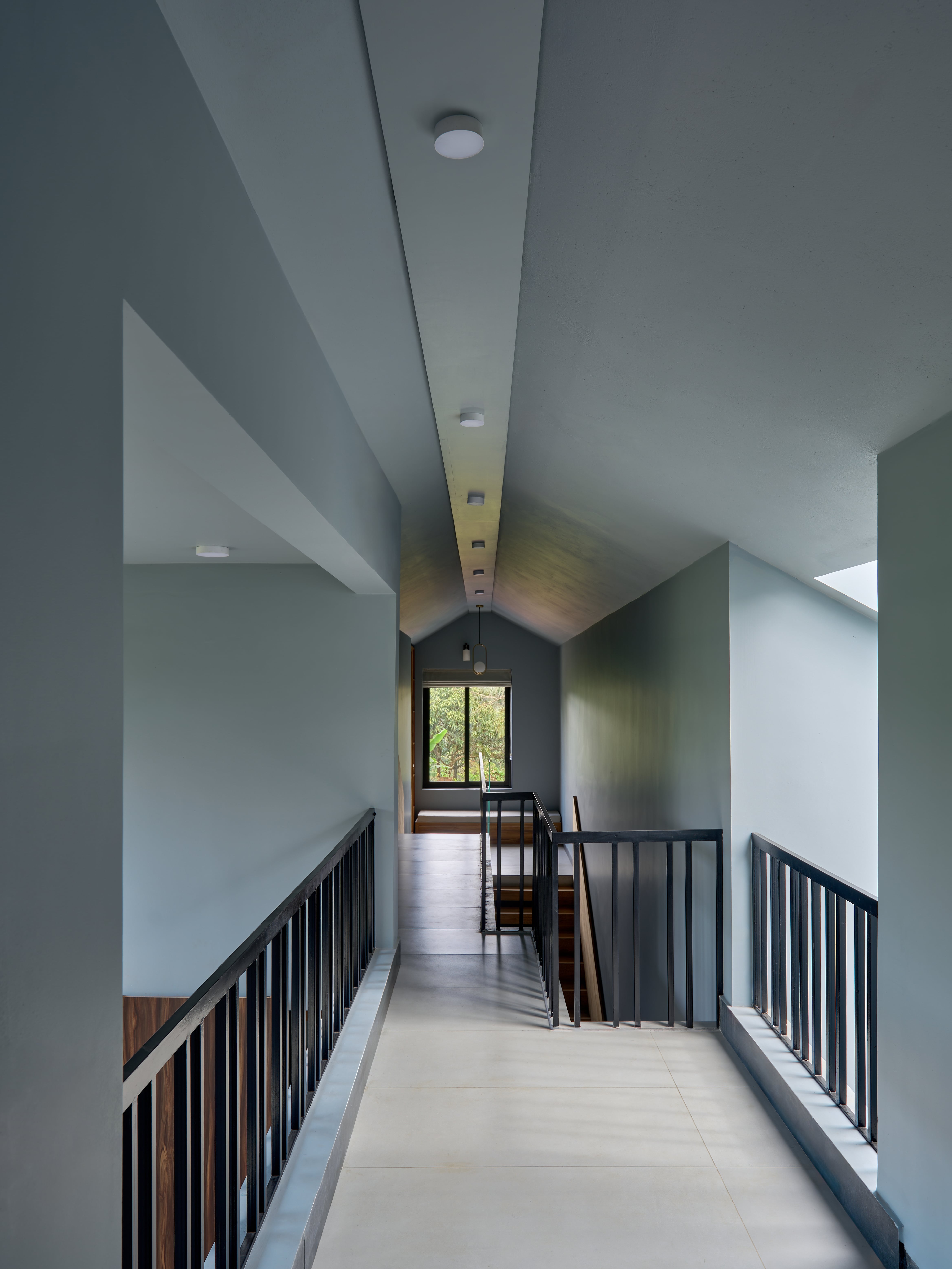
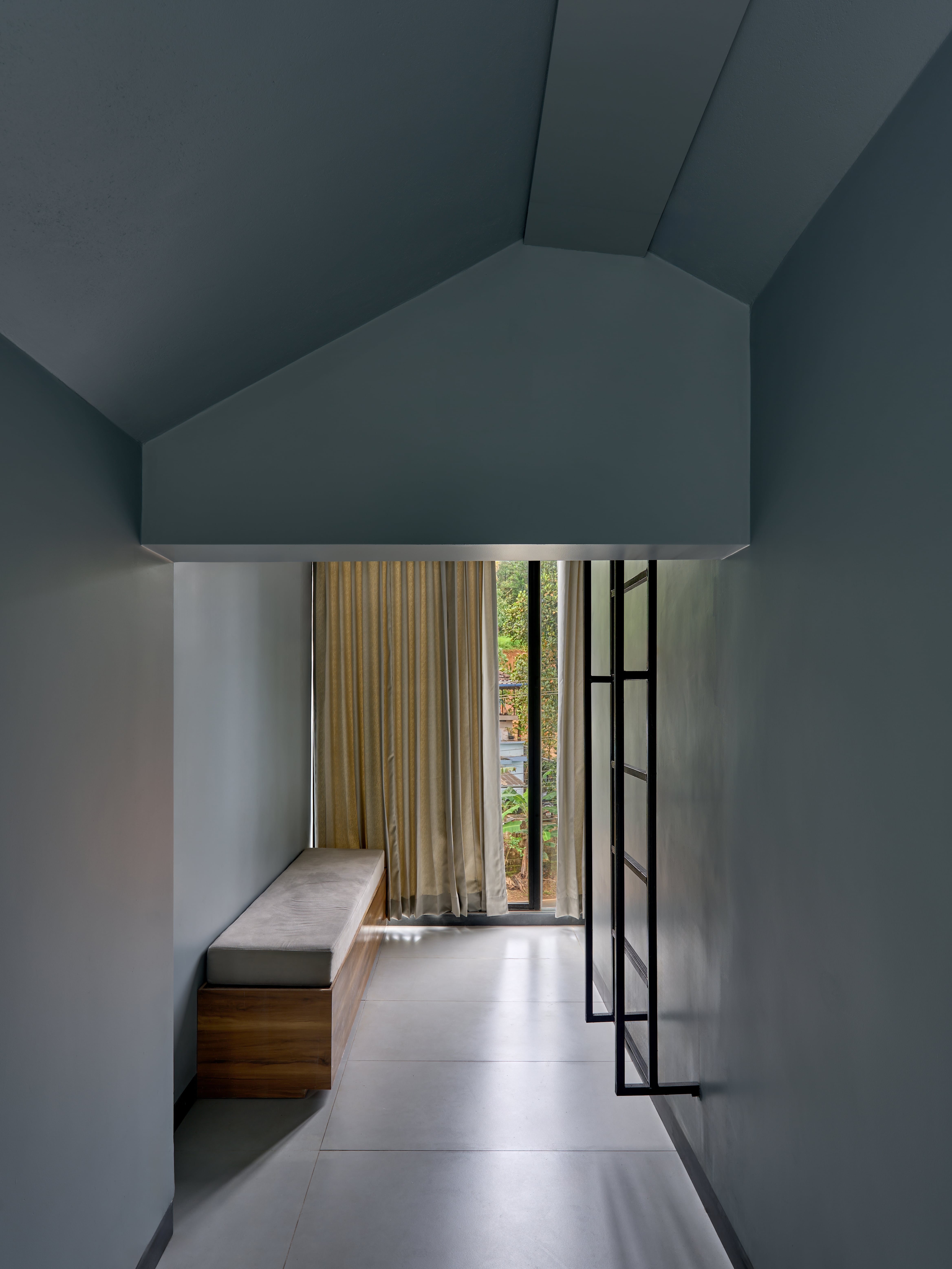
At the far extremities, the passage thickens into small pauses. One end terminates in a generous window seat, a timber-and-cushion ledge that transforms the landing into a compact reading nook overlooking the trees. The other end offers a quieter alcove with a bench and tall window, where the light is softer and the view more filtered, making it a natural place to sit with a book or simply watch the rain. These pockets are deliberately minimal—just a bench, a rail, a pendant—so that the experience is driven by proportion, light, and the sense of being slightly removed from the busier rooms.
The ceiling geometry plays a crucial role in tying this level back to the rest of the house. A continuous central band runs along the spine, subtly lowering the height and bringing the scale closer to the body, while the pitched surfaces to either side echo the volumetric play of the living room and dining space below. As a result, the upper floor feels both connected and distinct: a calm, elevated promenade that stitches together bedrooms and private corners, while quietly extending Fench House’s larger narrative of retreat, balance, and measured openness.

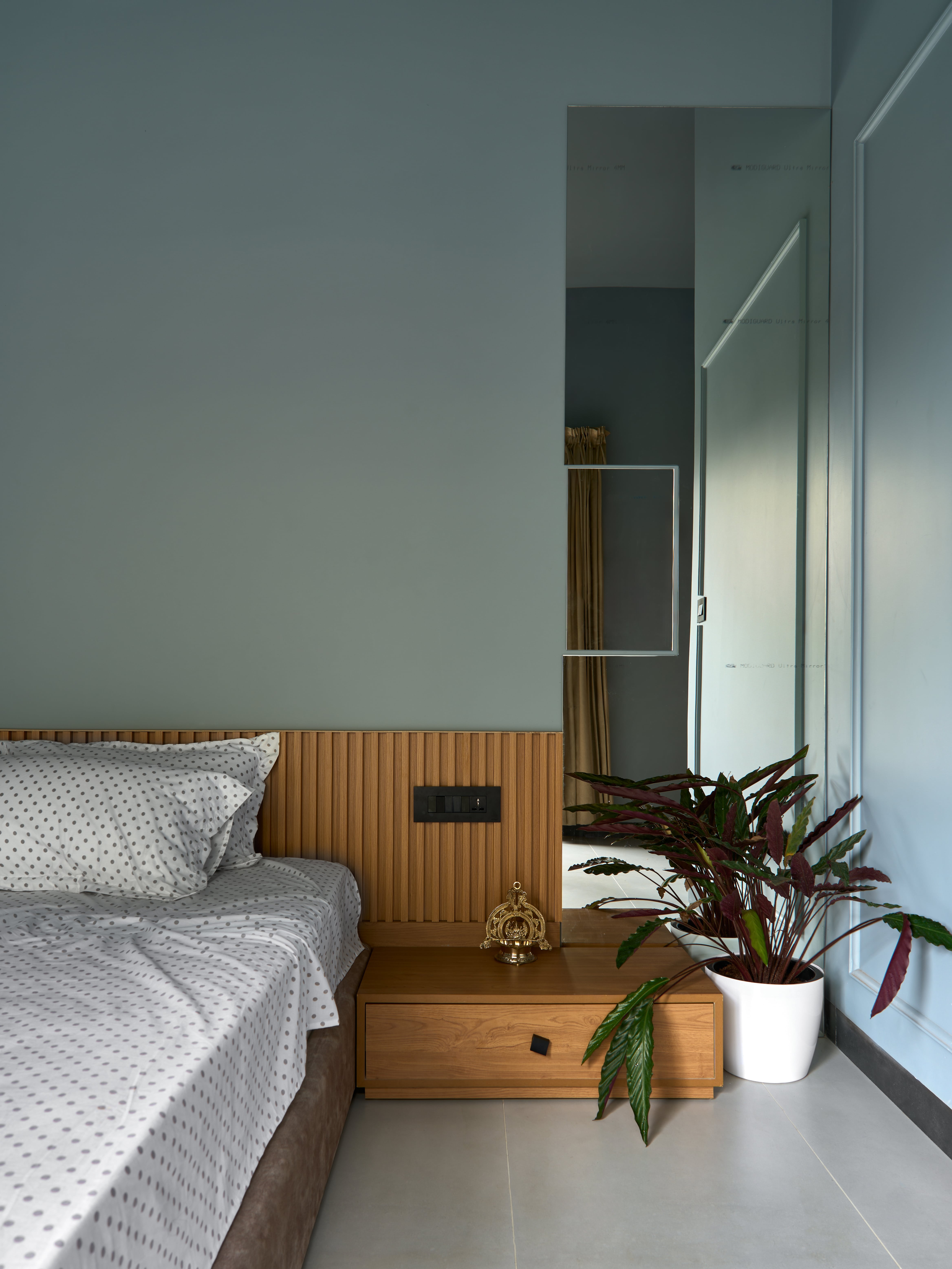
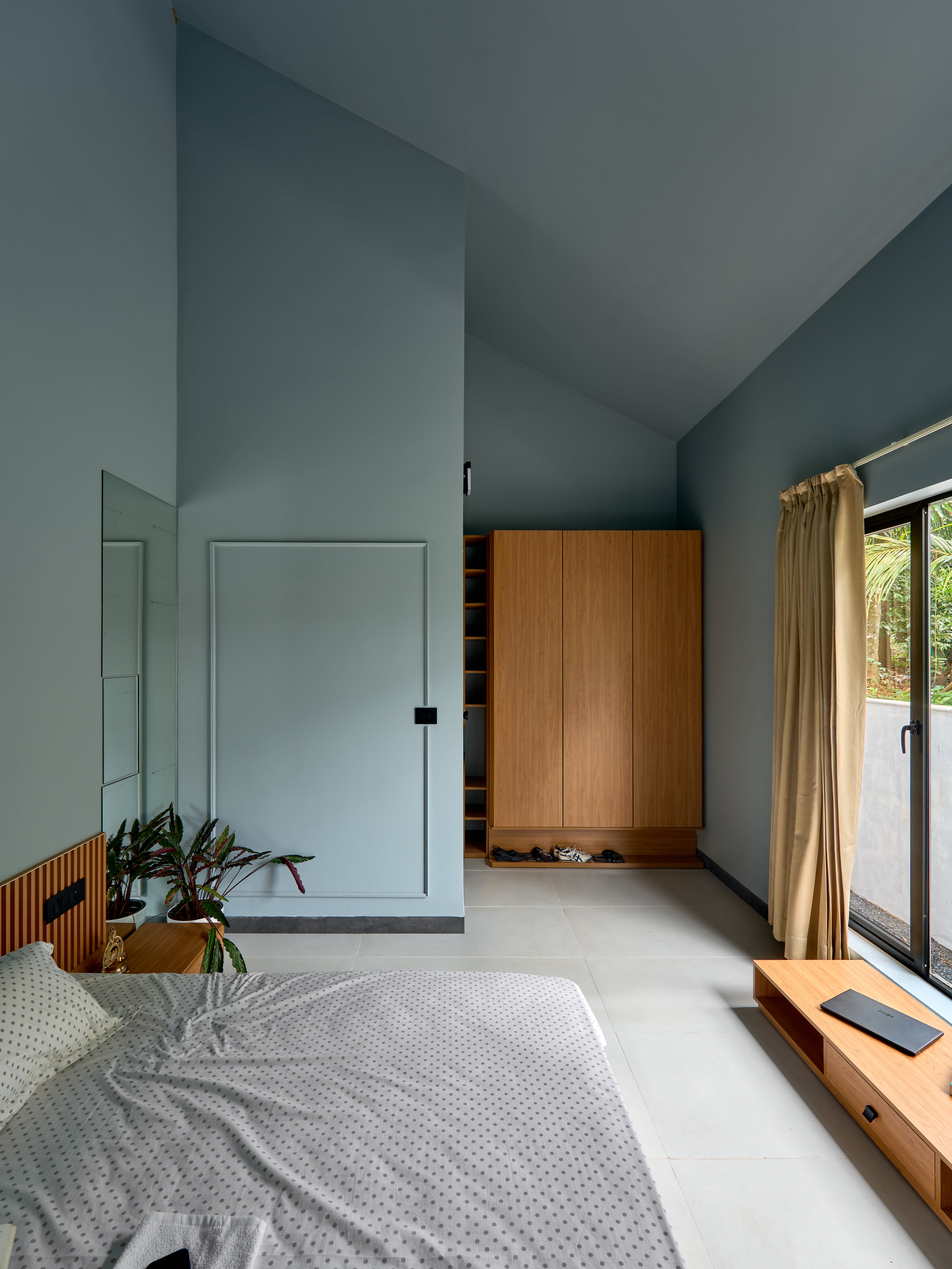
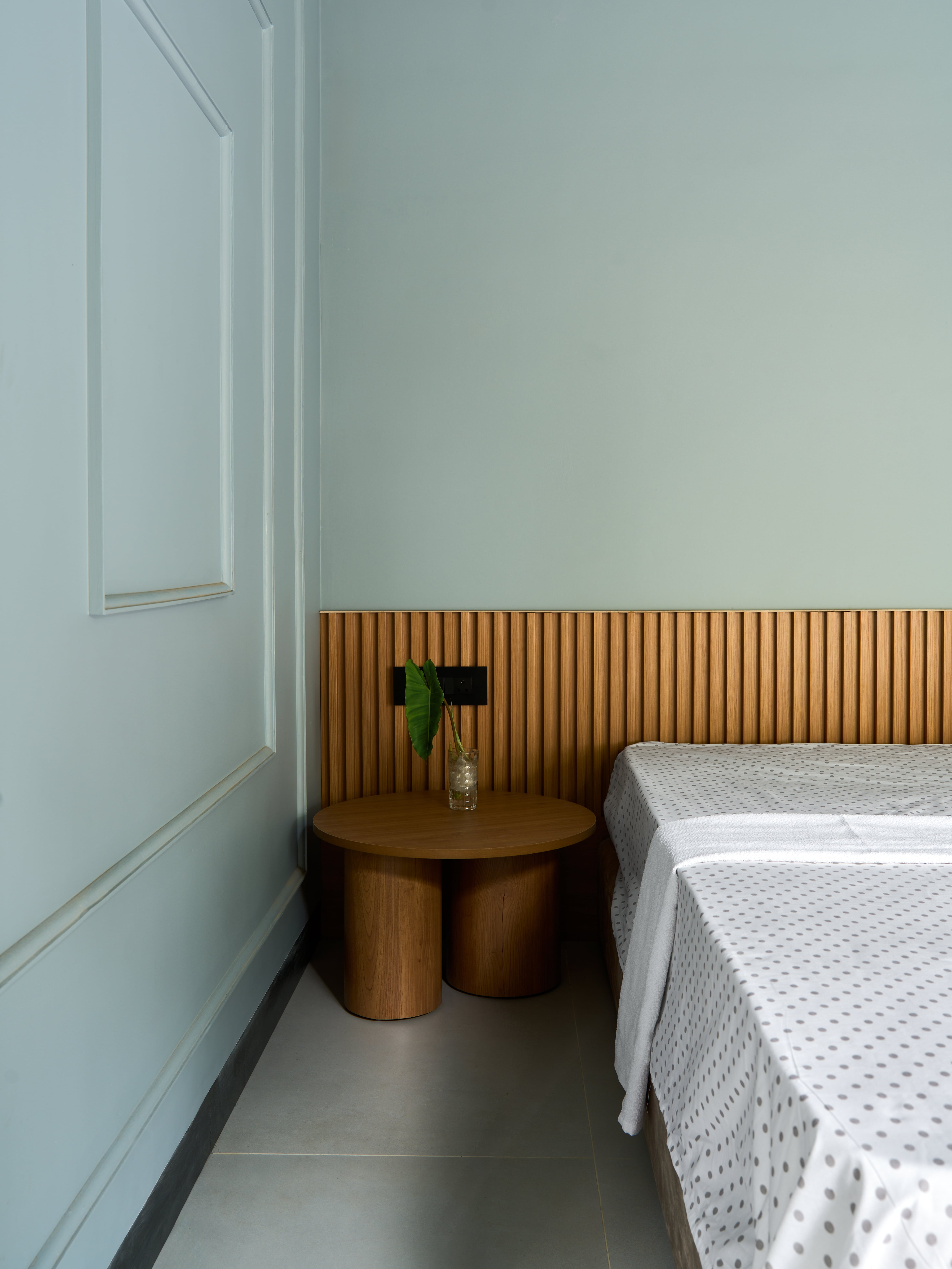
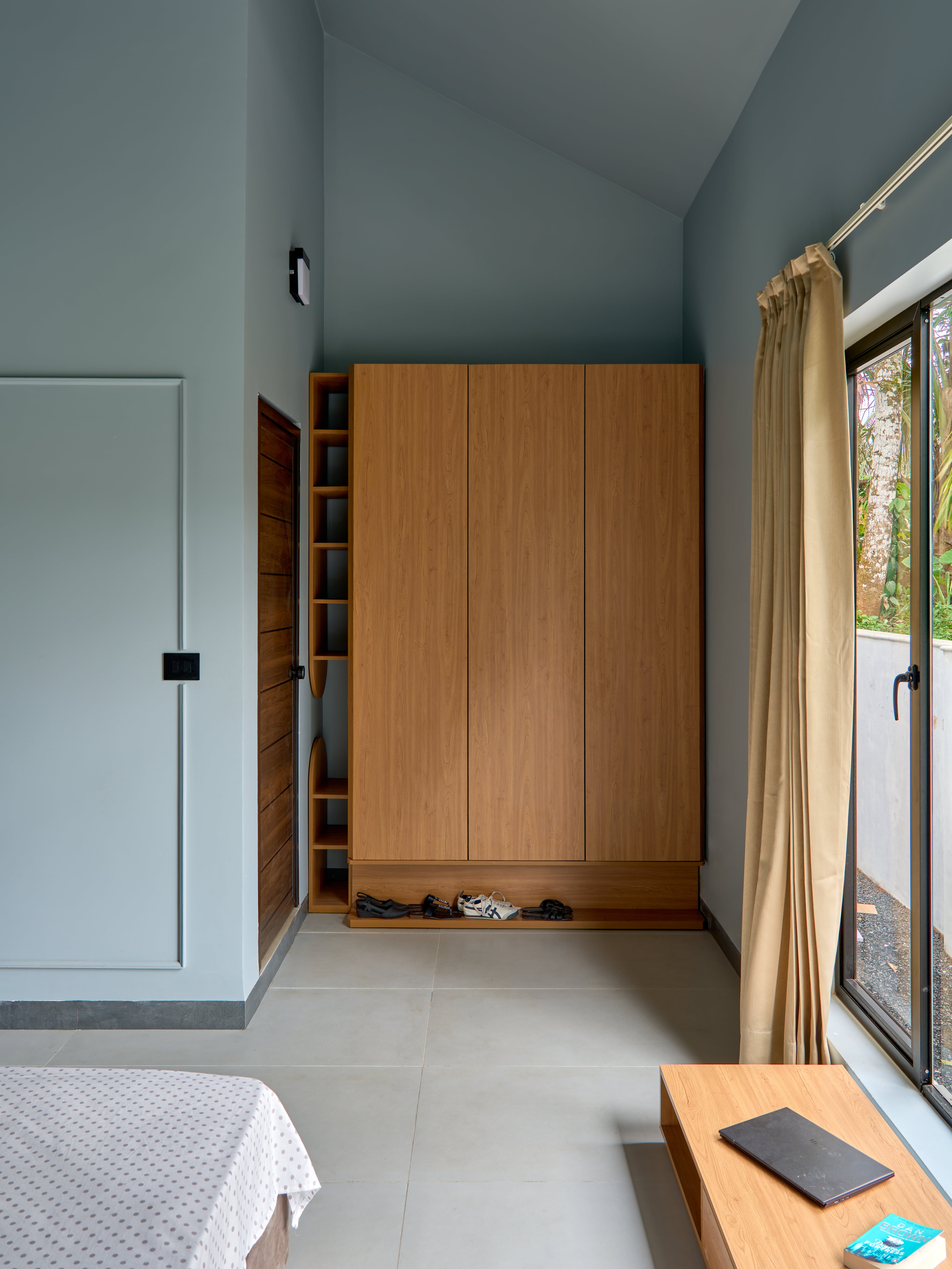
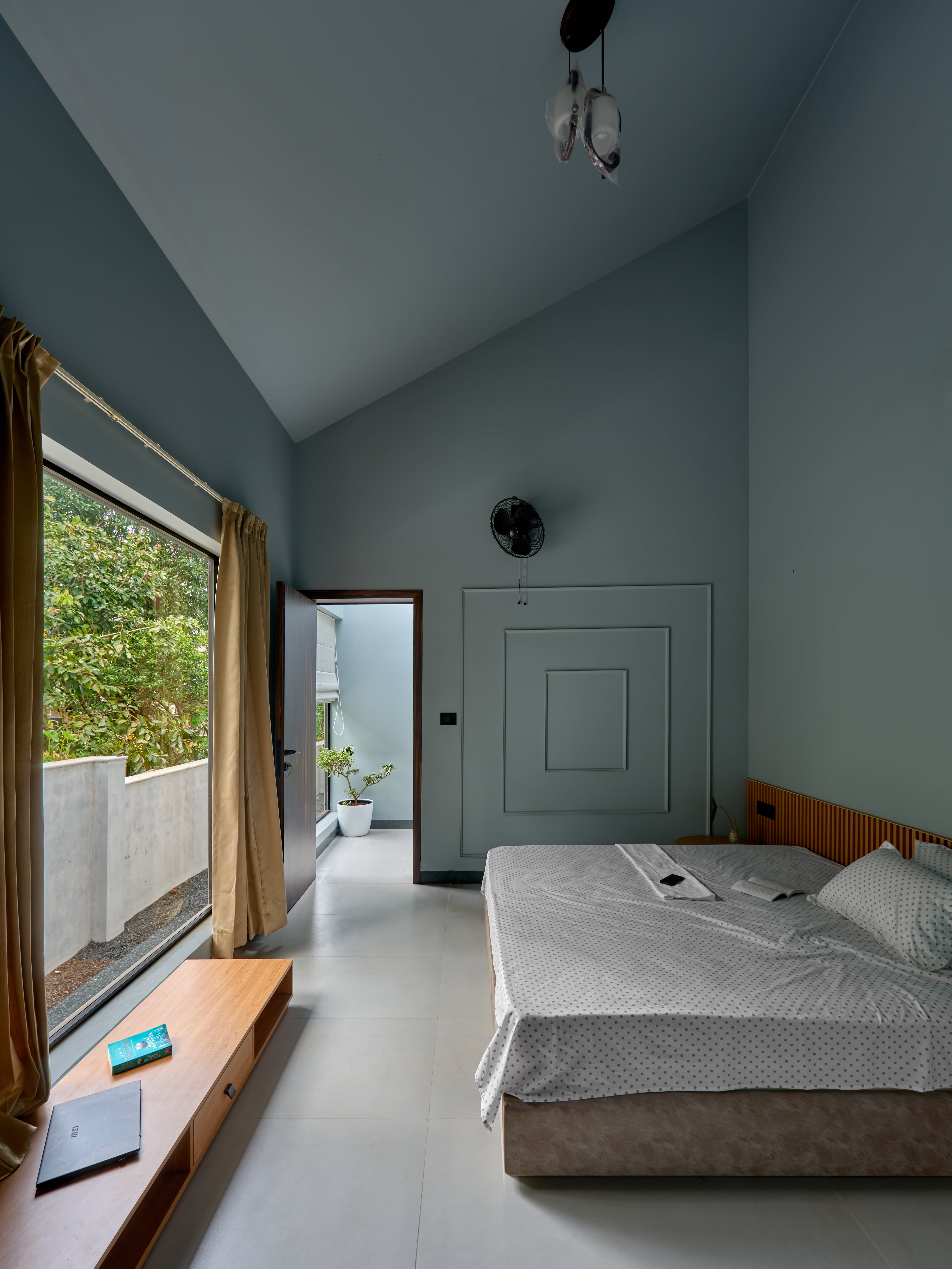
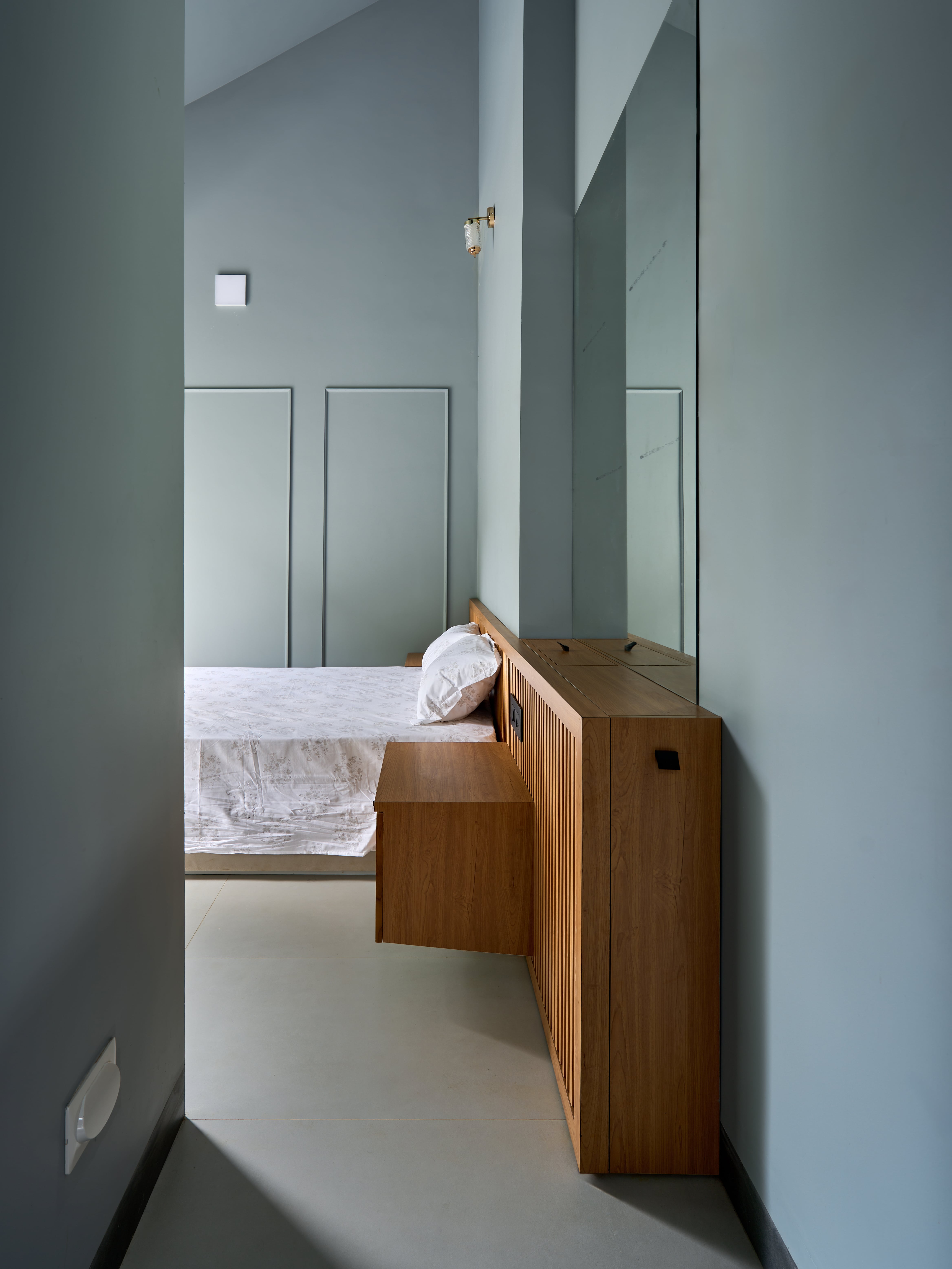
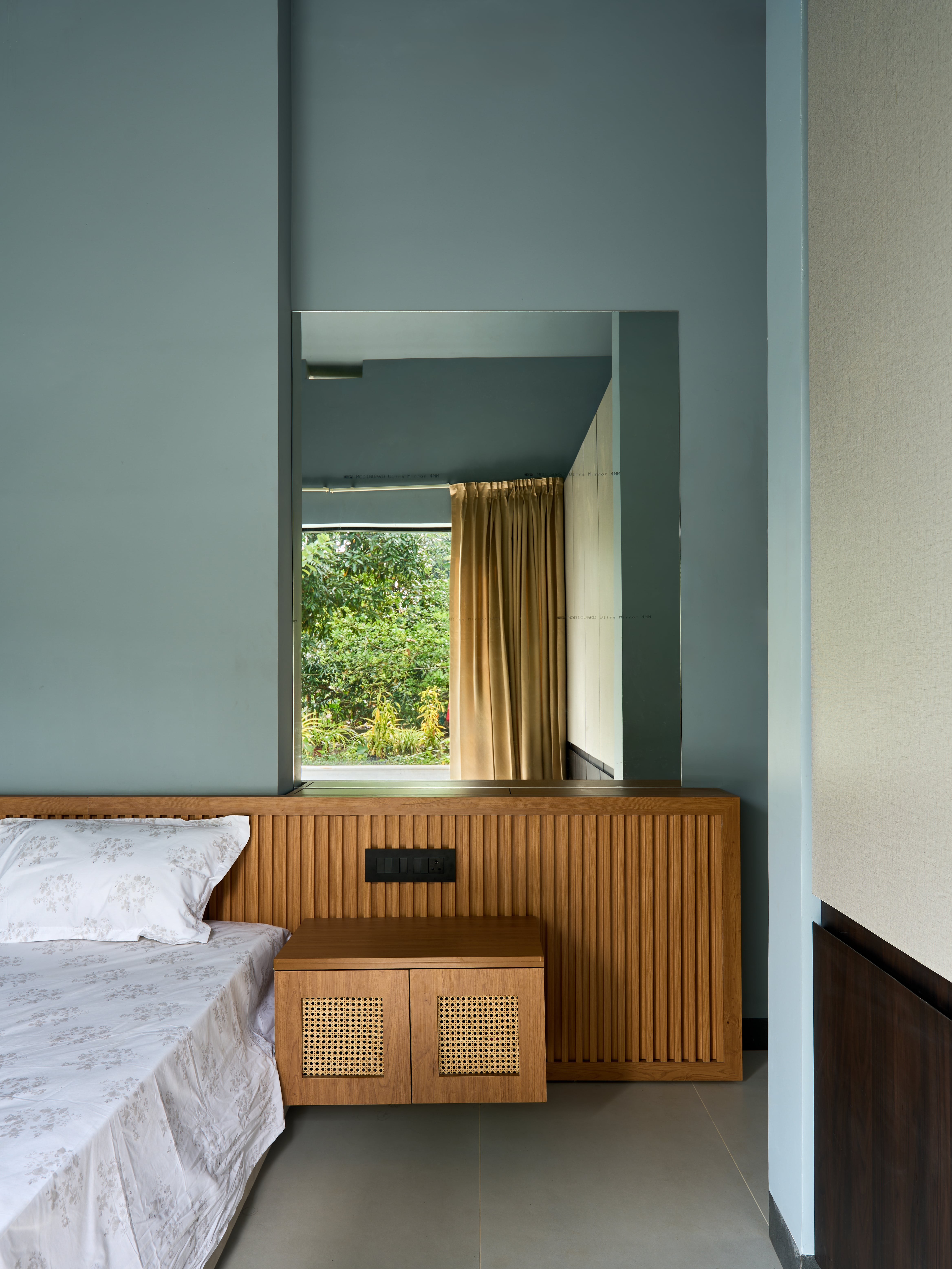
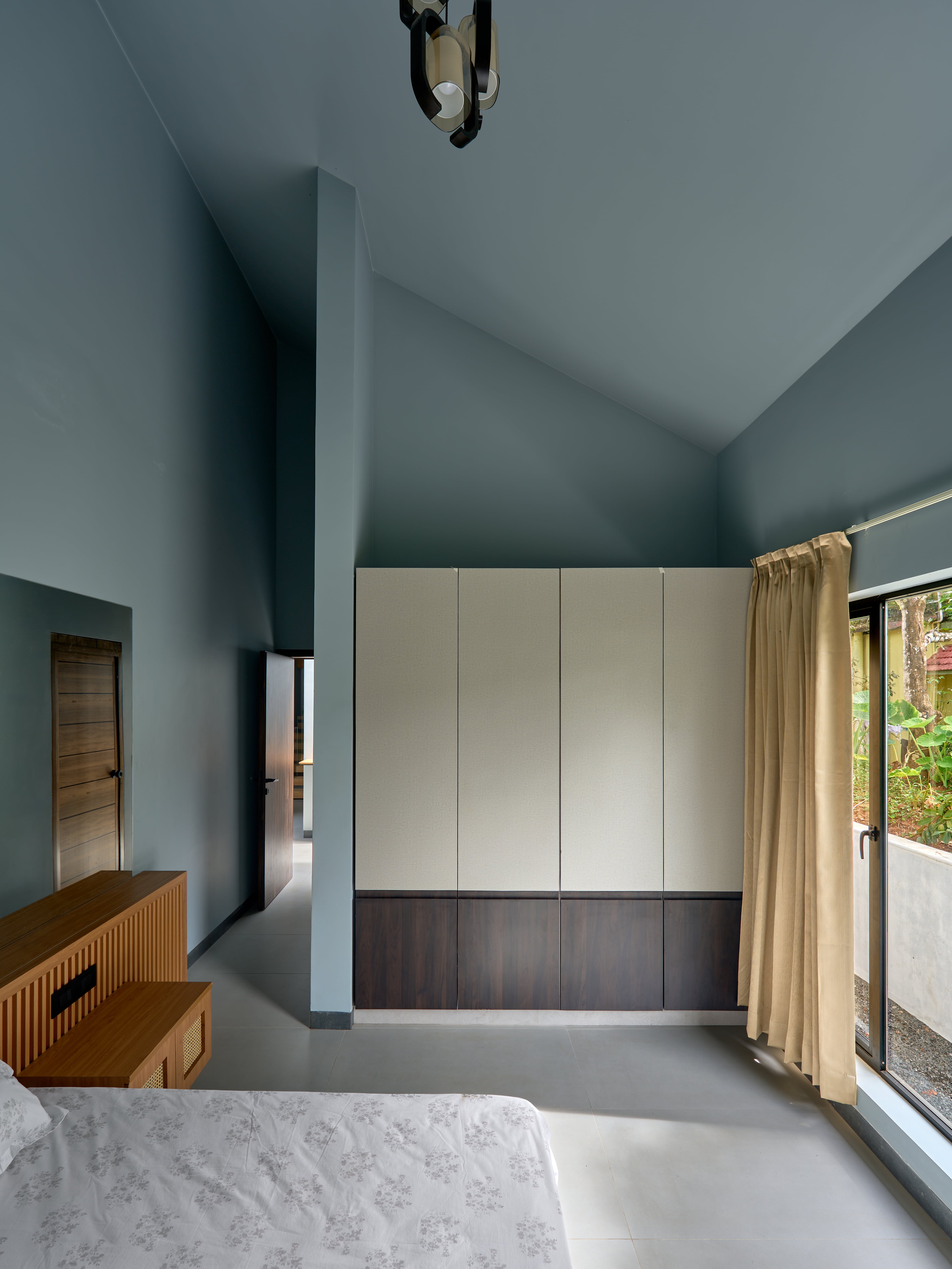
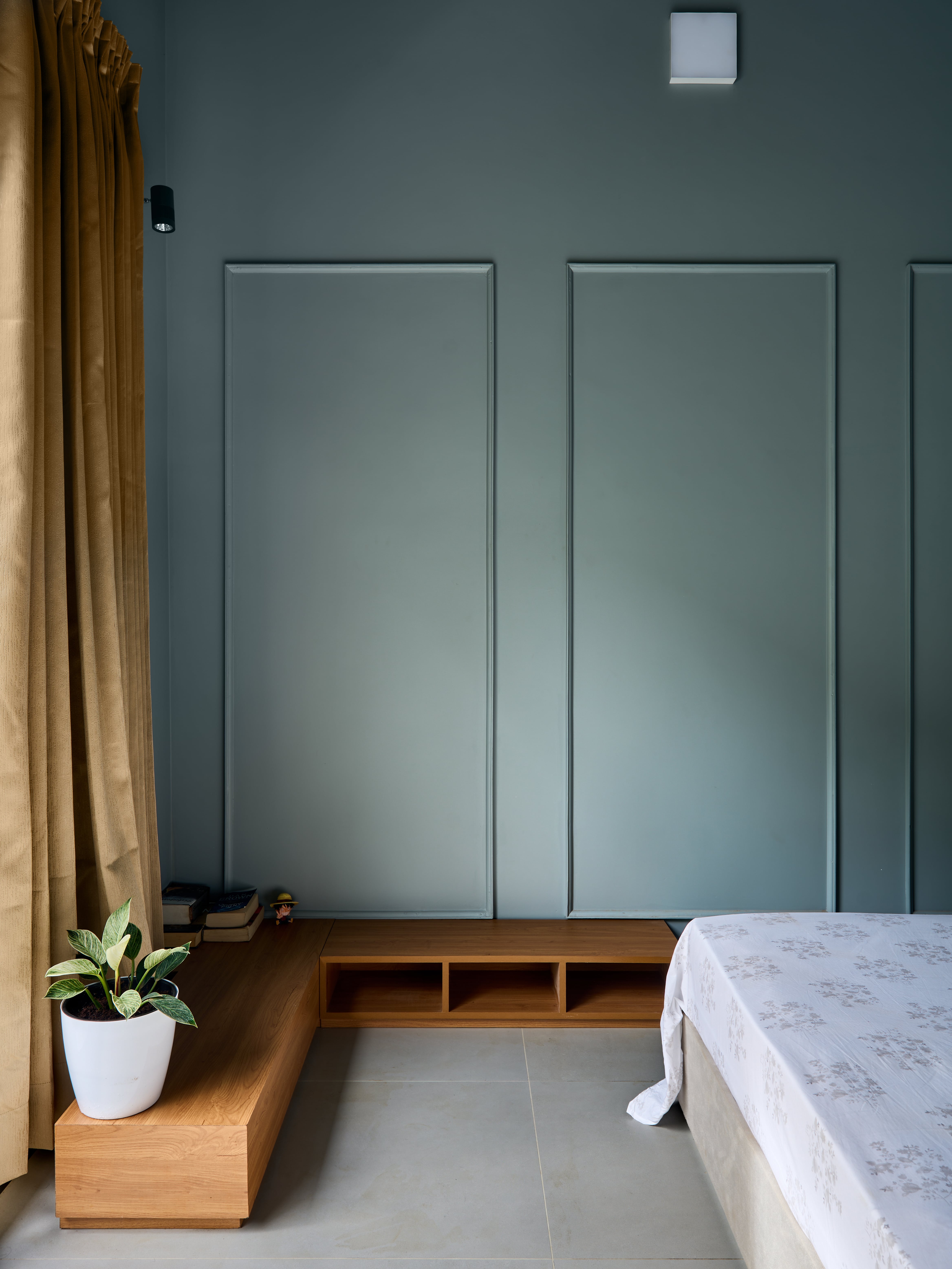
In the bedrooms of Fench House, the language of calm that runs through the home is distilled into its most intimate form. The same soft blue envelope continues here, but it is allowed to stay largely unbroken, so the eye rests on long, quiet planes of colour rather than pattern or ornament. Within this shell, a low timber bed and fluted headboard introduce warmth and tactility, grounding the room without disturbing its stillness.


The Firm Provides Comprehensive Services In Architecture And Engineering. Planning And Interior Design For New Facilities, Both Residential And Commercial, As Well As Renovations And Landmark Restorations.